In this paper, we discuss consensus problems for networks of dynamic agents with fixed and switching topologies. We analyze three cases: 1) directed networks with fixed topology; 2) directed networks with switching topology; and 3)...
moreIn this paper, we discuss consensus problems for networks of dynamic agents with fixed and switching topologies. We analyze three cases: 1) directed networks with fixed topology; 2) directed networks with switching topology; and 3) undirected networks with communication time-delays and fixed topology. We introduce two consensus protocols for networks with and without time-delays and provide a convergence analysis in all three cases. We establish a direct connection between the algebraic connectivity (or Fiedler eigenvalue) of the network and the performance (or negotiation speed) of a linear consensus protocol. This required the generalization of the notion of algebraic connectivity of undirected graphs to digraphs. It turns out that balanced digraphs play a key role in addressing average-consensus problems. We introduce disagreement functions for convergence analysis of consensus protocols. A disagreement function is a Lyapunov function for the disagreement network dynamics. We proposed a simple disagreement function that is a common Lyapunov function for the disagreement dynamics of a directed network with switching topology. A distinctive feature of this work is to address consensus problems for networks with directed information flow. We provide analytical tools that rely on algebraic graph theory, matrix theory, and control theory. Simulations are provided that demonstrate the effectiveness of our theoretical results. He has been a Postdoctoral Scholar in the Department of Control and Dynamical System, California Institute of Technology, Pasadena, since 2001. His research interests include distributed control of multiagent systems, formation control, consensus and synchronization problems, flocking/swarming, particle-based modeling and simulation, self-assembly, cooperative robotics, mobile sensor networks, self-organizing networks, folding and unfolding, biomolecular systems, dynamic graph theory, graph rigidity, computational geometry, nonlinear control theory, and control of aerospace vehicles and UAVs.


![Fig. 1. Original megapixel image with pixel values in the range [0,255] and its wavelet transform coefficients (arranged](https://figures.academia-assets.com/6282527/figure_001.jpg)




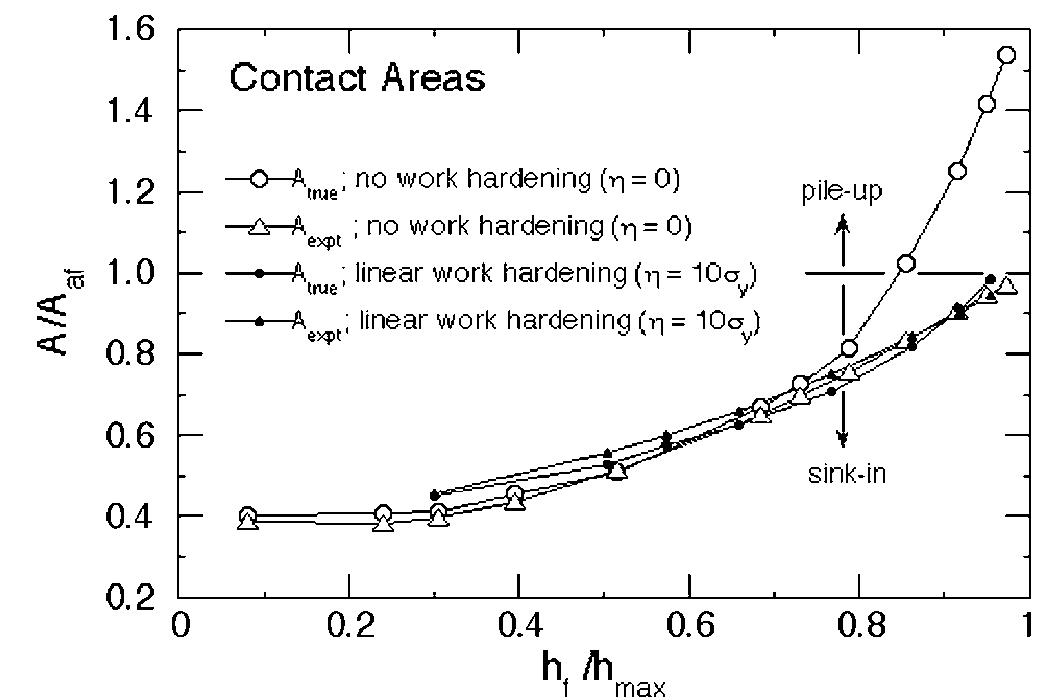
![FIG. 3. Concepts used to understand and define the effective indenter shape (from Ref. 35). The ideas underlying the effective indenter shape are outlined in Fig. 3. The basic principles are derived from observations gleaned from finite element simulations of indentation of elastic—plastic materials by a rigid conical indenter with a half included angle of 70.3°.*° During the initial loading of the indenter [Fig. 3(a)], both elastic and plastic deformation processes occur, and the indenter conforms perfectly to the shape of the hardness impres-](https://figures.academia-assets.com/36597907/figure_003.jpg)




![Gesign area tnat ?s available for the construction of the fillet. For the sake of comparison, a design optimization was also carried out for the case of rigidity that is linear in the design variable, as for variable thickness sheets, cf. Section 2. Suc design problems have been studied in detail in [51], and are very well-behaved problem: Figure 10 shows results for this type of problems and illustrates that this representation stiffness gives a good indication of the two-dimensional optimal shape for high volum fractions, while for low volume fractions it is difficult to interpret the results so as to define two-dimensional shape. This is, of course, not surprising as we are dealing with a tru three-dimensional problem that just happens to have a two-dimensional model. That is th variable thickness is a hidden three-dimensional feature. However, the design of variab] thickness sheets does indeed give well-defined shapes as three-dimensional structures. The testing of the design method using composite materials has been carried out for variou different formulations that all relate to the description of the method given in Section 4. Tw](https://figures.academia-assets.com/33987352/figure_008.jpg)


![“MVE PUL HO ‘216 O18 SOUIN[OA ‘sUdIsap podumn] SuNNses oy) UUINTOS pueYy-7Yy3IE ‘SuIduIN] 0} JO y[NsAa1 SMOYs UUIN[OS pueY-2T] °psjej03 aq WED Jey) Sajoy arenbs se sploA YIM Y aseD “ssodoid Suiduiny ayy Jo syNsey “pT “By](https://figures.academia-assets.com/33987352/figure_013.jpg)


![*Pyroceram, Corning Glass Works, Corning, N. Y. Commercial sheet glass. ‘National Bureau of Standards, Washington, D. C. “Coors Porcelain Co., Golden, Colo. ‘Vistal, Coors Porcelain Co. ‘Linde, Union Carbide Co., New York, N. Y. §Norton Co., Worcester, Mass. "CSIRO, Australia. ‘Texas Instruments, Inc., Dallas. ‘Rods, [0001] 30° to axis. "Disks, [111] parallel to axis. ‘DT=double torsion, DCB=double cantilever beam. “University of California, Berkeley. ‘Rockwell International Science Center, Thousand Oaks, Calif. ‘National Bureau of Standards. Table I. Materials Used in Indentation Toughness Studies](https://figures.academia-assets.com/18899875/table_001.jpg)


![Fig. 1. Areas of research in thermal storage systems [1]. equipment or in installations with reduced prices for electrical energy consumed during off-peak hours. Nowadays, security of energy supply is often achieved with extra equipment. The use of phase change materials (PCMs) could either avoid or reduce this extra equipment. As it will be seen later in this paper, thermal inertia and thermal protection is the area where the PCMs have achieved a higher penetration in the market. Low mama wrens an oo eaviraw AP ao¢isdéan dan Geaw «oth "TEO aoadnnw whaon nhawewsa ewotacsale Tha](https://figures.academia-assets.com/30356449/figure_001.jpg)
![Fig. 2. Classification of energy storage materials [1].](https://figures.academia-assets.com/30356449/figure_002.jpg)


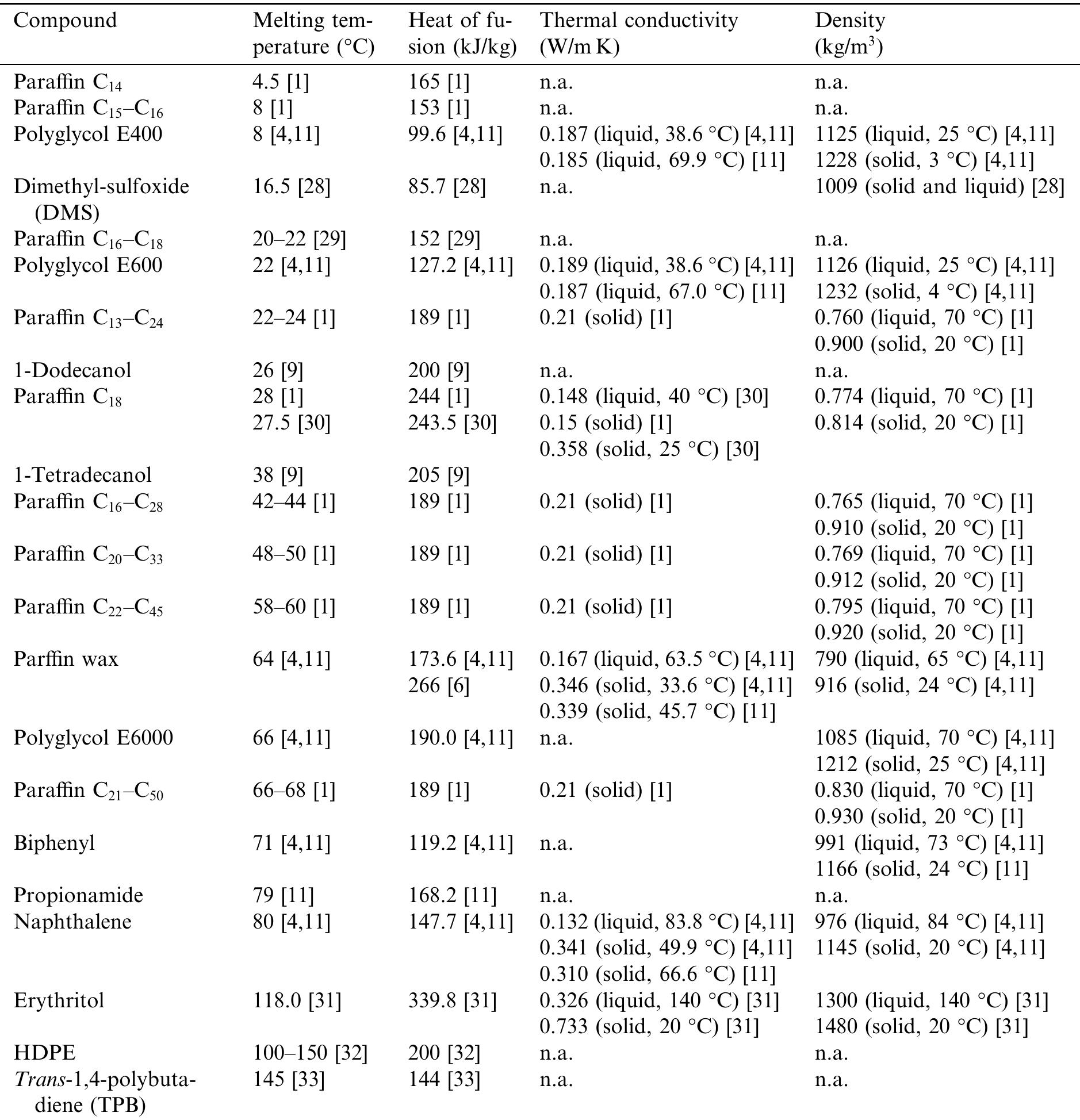
![Table 1 (continued) n.a.: not available. B. Zalba et al. | Applied Thermal Engineering 23 (2003) 251-283 a a Pa as As far as concerns the storage temperature or phase change, the heat transfer in accumulators can be improved choosing the PCM in such a way that its phase change temperature optimises the thermal gradient with respect to the substance with which the heat is being exchanged (Farid [46], Hassan [64], Strub [65]). For example, with paraffins and alkanes it is possible to vary the number of carbon atoms or form different molecular alloys which allows a practically continuous varia- tion of the phase change temperature within certain ranges.](https://figures.academia-assets.com/30356449/table_003.jpg)


![Organic eutectics with potential use as PCM Table 5 on observation over experimental set-ups [78,79]. Porisini [80] tested the corrosion of four com- mercially available salt hydrates used as PCMs in 1988. Recently, Cabeza et al. [81-84] studied corrosion resistance of five common metals (aluminium, brass, copper, steel and stainless steel) in contact with molten salt hydrates (zinc nitrate hexahydrate, sodium hydrogen phosphate do- decahydrate, calcium chloride hexahydrate, sodium carbonate, potassium hydrogen carbonate, potassium chloride, water, sodium acetate trihydrate, and sodium thiosulphate pentahydrate) in an immersion corrosion test. ot @ a ee a | ay i rr ee o a, a, er, ee ey](https://figures.academia-assets.com/30356449/table_007.jpg)


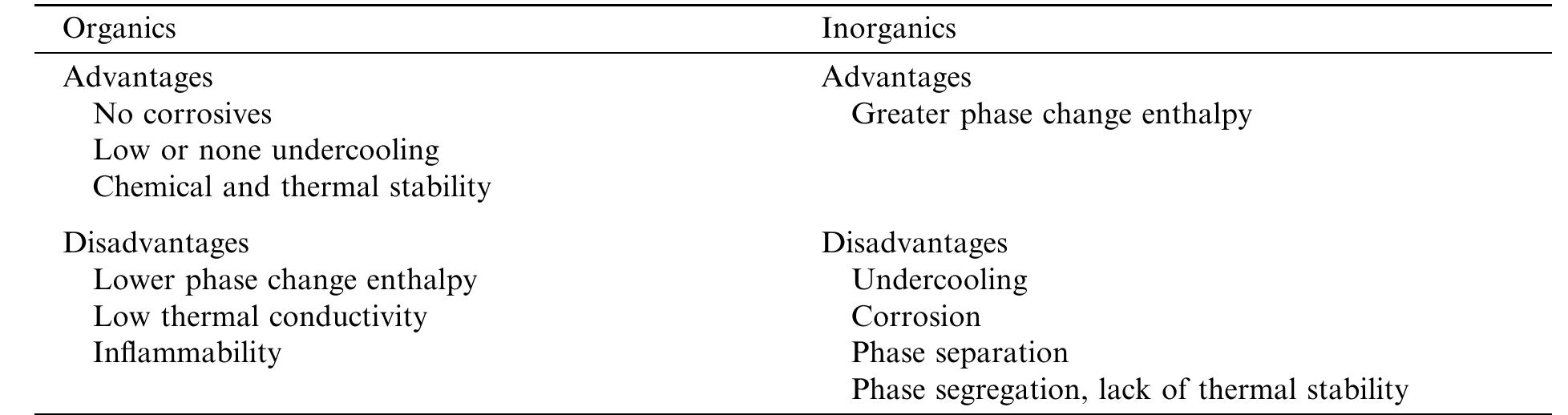

![B. Zalba et al. | Applied Thermal Engineering 23 (2003) 251-283 In the past, the earliest works basically concentrated on analysing pure substances, often water (for ice stores). Studies that can be cited include London [98], Goodman [162], Lazaridis [100] and Saitoh [163]. In subsequent years, and even quite recently and due to the implementation on a commercial and industrial scale of the so-called ice storage systems, abundant information re- lating to water as a storage substance has also appeared i in the literature. we ite: Pn a aa Pa ee qe](https://figures.academia-assets.com/30356449/table_012.jpg)


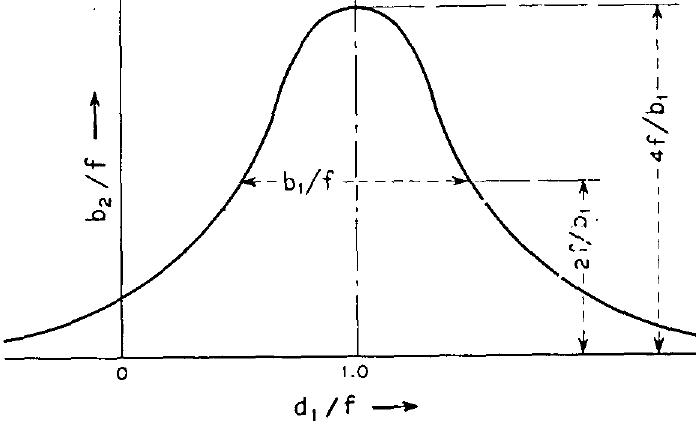


![Fig. 16. Geometry of a spherical-mirror resonator with finite mirror apertures and the equivalent sequence of lenses set in opaque absorbing screens. In deriving the integral equations, it is assumed that a traveling TEM wave is reflected back and forth between the mirrors. The resonator is thus analogous to a trans- mission medium consisting of apertures or lenses set in opaque absorbing screens (see Fig. 16). The fields at the two mirrors are related by the equations [24]](https://figures.academia-assets.com/50650897/figure_015.jpg)


![Fig. 23. Diffraction loss per transit (in decibels) for the TEMa mode of a stable resonator with circular mirrors. The diffraction losses for the two lowest order (TEMoo and TEMo:) modes of a stable resonator with a pair of identical, circular mirrors (a1=42, gi=g2=g) are given in Figs. 22 and 23 as functions of the Fresnel number NV and for various values of g. The curves are obtained by solving (77) numerically using the method of successive approximations [31]. Corresponding curves for the phase shifts are shown in Figs. 24 and 25. The horizontal por- tions of the phase shift curves can be calculated from the formula](https://figures.academia-assets.com/50650897/figure_022.jpg)


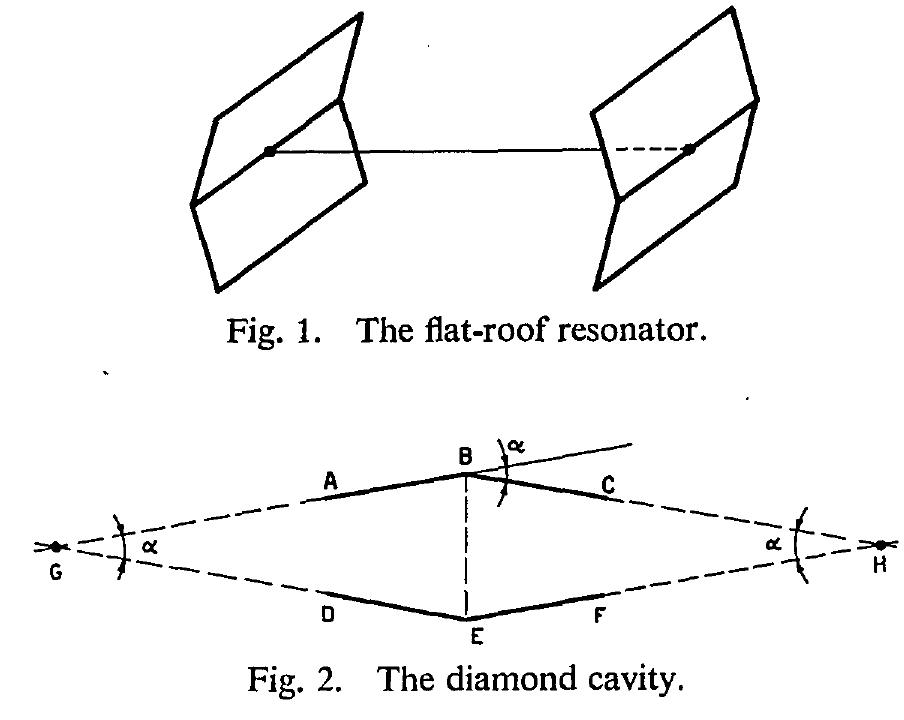

![FIG. 2. Calculated GVD parameter 8, (top) and D (bottom) for PCFs with parameters as shown: A=1 wm, ¢=0.6 um; A=1.6 wm, ¢=1.4 wm [that used by Ranka et al. (2000a)]; and standard Corning SMF28 single-mode fiber.](https://figures.academia-assets.com/30925103/figure_002.jpg)

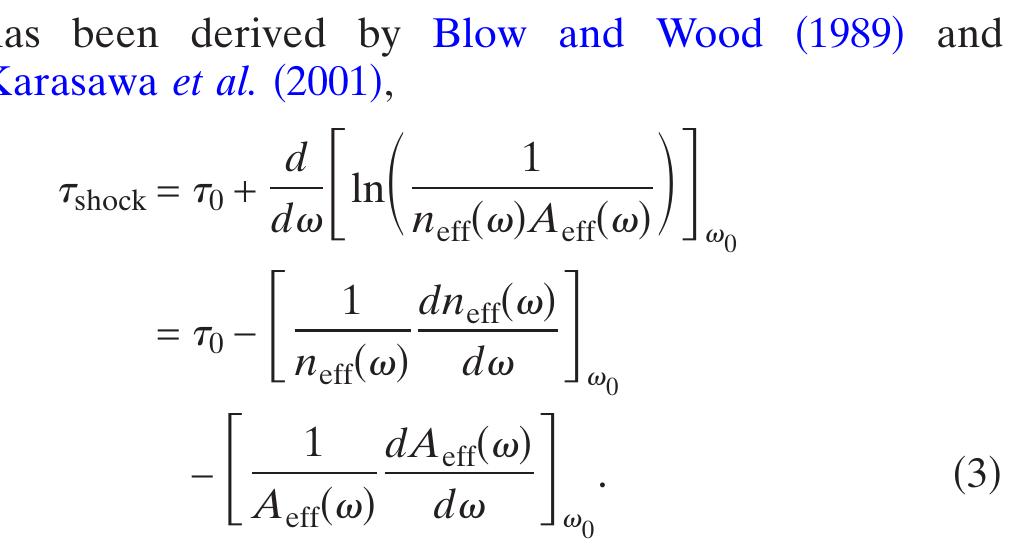
![The time-domain envelope is obtained from A(z,?) =(1/27)f%,,A(z,@—w)exp[—i(w—)t|]dw, and note that the amplitude is normalized such that |A(z,t)|* gives the instantaneous power in watts. With the change of vari- able T=t-,z, we transform into a comoving frame at The time-domain envelope is obtained from A(z,?)](https://figures.academia-assets.com/30925103/figure_004.jpg)


![Fig. 4. The density phase transition curve of MD simulation. The phase transition of ZrO, is very complicated, but it is a good choice for MD algorithm checking. With a heat- ing rate of 10 from 2100 to 3000 K, the phase transition from tetragonal to cubic is simulated successfully by a MD process starting with a tetragonal sample. The variations of the density are plotted in Figure 4. Note that a similar curve has been given in Ref. [17] where the pressure was controlled by a scaling of the MD cell, which could not be verified to yield the correct NPT ensemble. Figure 5 depicts the variations of the effective axial ratio of (a+ b)/2c. From the phase diagrams, transition from tetrago- nal to cubic can be identified easily. In Figure 5, due to the initialization of tetragonal phase, the axial ratio (0.922)](https://figures.academia-assets.com/45335064/figure_006.jpg)


![When we keep in mind that special functions of com- plex arguments are now readily available through languages such as Mathematica,*? or from various We suggest that Eq. (5) also be expressed in terms of confluent hypergeometric functions, namely, the Kummer functions of the second kind U(a, b, z). By employing the relation between erfc(z) and U(a, 6, z) [cf. Ref. 41, Eq. (13.6.39)],](https://figures.academia-assets.com/31300981/figure_002.jpg)


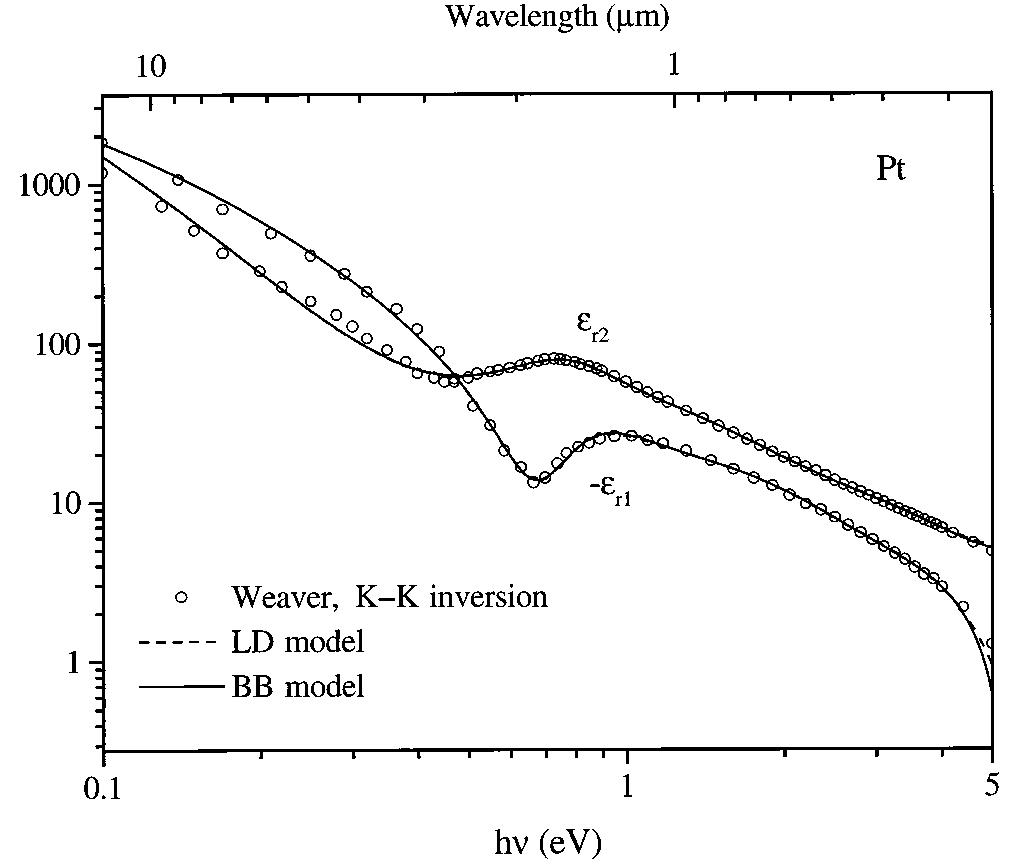


![Fig. 14. Calculated phase changes on reflection for four GaAs/ metal interfaces: GaAs/100 nm Ag, GaAs/100 nm Au, GaAs/100 nm Al, and GaAs/100 nm Pt. wave optical thickness (QWOT), the wave reflected from interface 1, which undergoes the phase change on reflection » = 7m [see Fig. 15(a)], is in phase with the wave reflected from interface 2, which experi- ences a phase shift 6 = —a while making a round trip through the last high-index layer (GaAs) and no phase change on reflection. The additional high- index QWOT layer (the phase-matching layer) is needed between the last semiconductor layer and the perfectly conductive metallic layer [see Fig. 15(b)] to keep the waves reflected from interfaces 1 and 2 in phase. Therefore the round-trip phase shift —7 in the phase-matching layer cancels the phase change on reflection at the semiconductor—metal interface, o = 7. If we now consider the real metal with the complex refractive index N = n — ik, the phase change on reflection » is determined by Eq. (14), where » < 7 at all wavelengths. To keep the waves reflected from interfaces 1 and 2 in phase, one needs](https://figures.academia-assets.com/31300981/figure_015.jpg)


![Fig. 2. An example of how scouts in formation focus their sensor assets so as to ensure complete coverage. Four robot scouts sweep from left to right in a diamond formation. The wedges indicate the sensor focus for each scout. Figure courtesy of Diane Cook of the University of Texas at Arlington [7].](https://figures.academia-assets.com/75669259/figure_002.jpg)


