ABSTRACT: Preface to the Guide: Focus and limitations: The compilation of this guide began in Spring 2007 as a series of check lists and book requests for the somewhat small collection of Egyptological and related works in M. H. Sterne...
moreABSTRACT: Preface to the Guide:
Focus and limitations:
The compilation of this guide began in Spring 2007 as a series of check lists and book requests for the somewhat small collection of Egyptological and related works in M. H. Sterne library at the University of Alabama at Birmingham. During the development of several courses on Ancient Egypt, the Ancient Near East, and other areas spanning Prehistory through to the Roman period (and later), the collection grew, and continues to expand, and began to require a research paper guide for students enrolled in courses dealing with these geographic areas and time periods. The nature of the prime cliental, namely undergraduate to MA students in a North American setting, in conjunction with limited funding, has steered –of necessity– the building of both Sterne library’s collections and this guide towards mostly English-language sources, less expensive works, and more easily available and more recent publications.
Overall aims:
In order to maximize student and public research usage of the existing, albeit still limited, collections, I have since compiled and incorporated selected journal articles, book chapters, encyclopedia entries, and other book titles from Sterne Library’s physical holdings (i.e., non-electronic sources) into diverse categories of research topics/subjects. In addition, every effort has been made to add a full listing of electronic sources (including links) available to researchers of the geographic and temporal areas covered by this guide (i.e., mainly Prehistoric to Roman period Egypt). The guide also provides general assistance for more serious/professional scholars (i.e., a quick reference to key articles, chapters, and volumes), but remains a tool aimed at English-speaking undergraduate-MA students and the public, focusing on Sterne’s holdings (note: other emerging Egyptological libraries will also approximate Sterne’s holdings).
Design and usage:
An attempt has been made to obtain sources spanning all aspects of Ancient Egypt and related areas, which have in-turn influenced the subdivision of the guide into general works, time periods, and diverse subject areas. Some of these categories have grown sufficiently large to merit further subdivision, such as the New Kingdom section, which has a general list of sources, materials regarding individual rulers, and a few affiliated topics of interest (Exodus; Sea Peoples). I have attempted to place each source (i.e., books; book chapters; encyclopedia entries; journal articles) under each pertinent topic category that it covers, but naturally I may have missed some categories, while there may be other complementary and broader works that cover such topics elsewhere. A list of the pertinent call number ranges has been placed at the end of the guide (see table of contents) to assist in the merits of additional shelf-browsing.
Beyond the guide:
Naturally there are numerous significant Egyptological sources outside Sterne Library’s holdings (including electronic links: e.g., JSTOR) that might be retrieved via interlibrary loan. Sterne Library’s current Egyptological resources, however, are sufficient to introduce most areas of Egyptological research, and enable the researcher to consult the endnotes/footnotes and bibliographic data listed in recent books, articles, and encyclopedia entries to compile a list of further resources that may either be accessed via interlibrary loan, or possibly by visiting directly a neighbouring professional Egyptological library: e.g., the instructor (UAB); Atlanta (Emory University); Memphis (Memphis State University).
The collections in other Birmingham and Alabama libraries have online links via Sterne Library’s website, and offer many duplicate and different Egyptological works that are often accessible to the public/students: e.g., Birmingham Public Library, Gorgas Library (UA). Naturally, I encourage students, faculty, and public researchers to see me for further assistance with this guide and their research topics.
Gregory Mumford (UAB)
Update: 15 Jan., 2021
PLEASE NOTE: This resource has received substantial updates in pertinent sections within the guide. Some additional sorting of various articles/entries is still required, but these articles can be found, unsorted, at the end of the guide (e.g., articles from KMT, JSSEA, EA, etc., listed chronologically and by issue). I anticipate another update in the following year ...




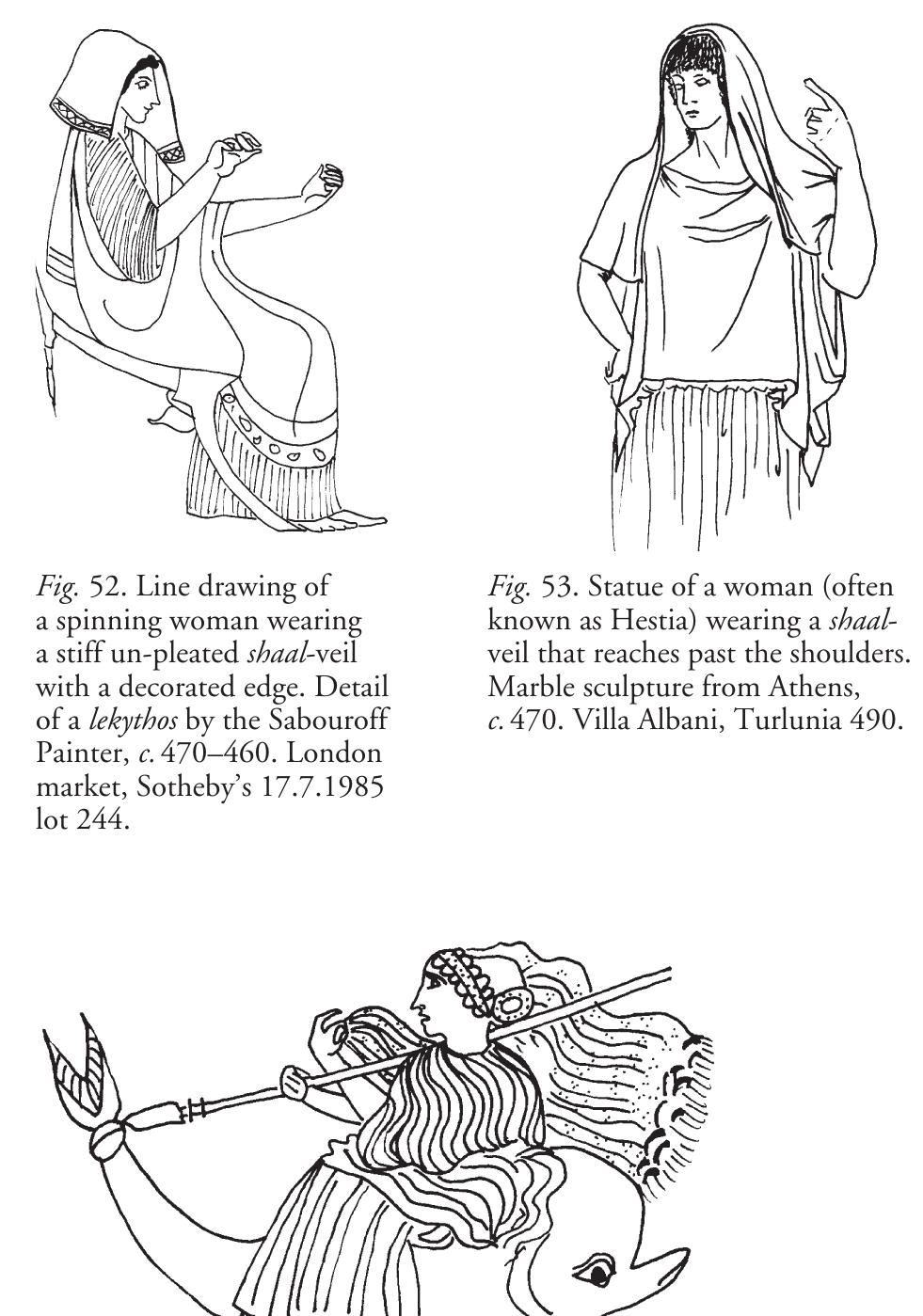


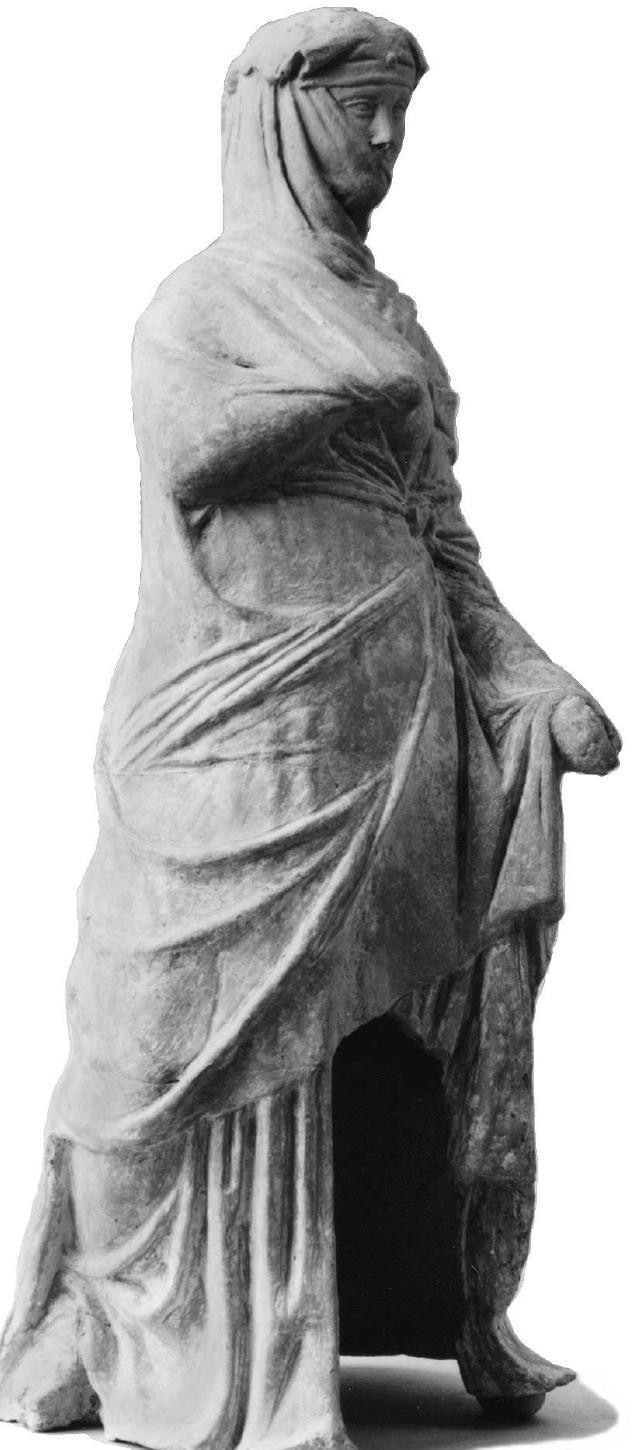










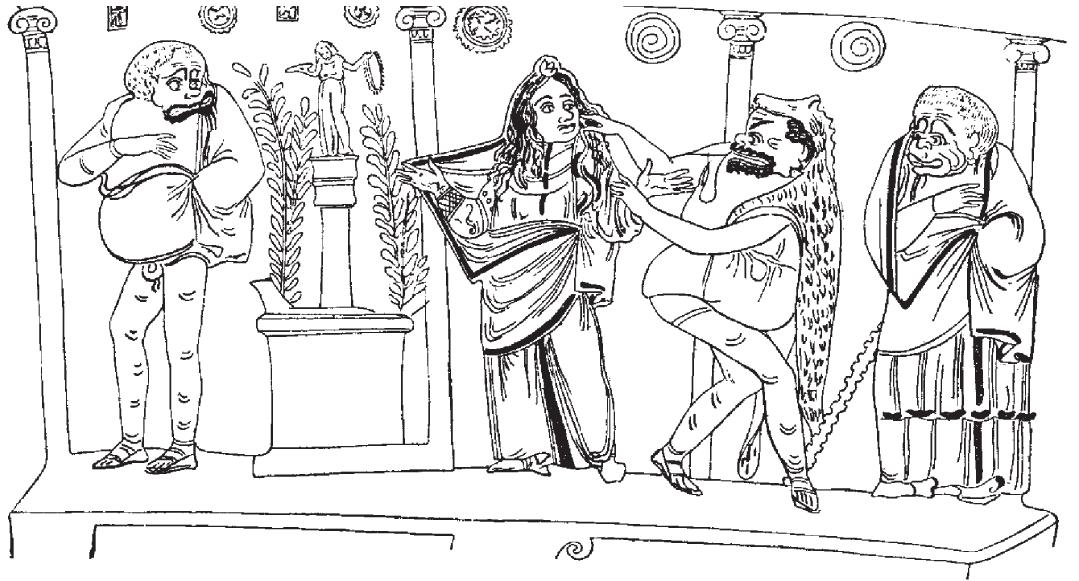




![Fig. 7. Line drawing from an Attic red-figure cup fragment by Douris, c. 480. London, private collection. the wrap regularly worn by women, which resembles an ample Aimation but is often made of very thin and clinging materials which allow the heavier folds of what is worn beneath to show through... [W]hen worn out of doors [it] usually envelops both arms and also hoods the head.”°](https://figures.academia-assets.com/36454124/figure_008.jpg)


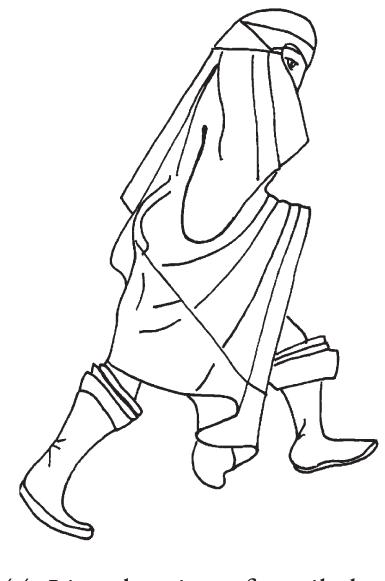
![Fig. 14. Line drawing of a woman wearing a mantle wrapped in such a way that it creates a yaimak and a turban. Lebes gamikos by the Marsyas Painter (detail) from Kerch, c.400 Bc. The State Hermitage Museum, St. Petersburg, 1475.3. Iberia], of which Artemidoros has told us. In some places, he says, they wear around their necks iron collars which have curved rods that bend overhead and project far in front of their foreheads; and at will they draw their veil (Aalumma) down over these curved rods, so that the veil, spread out, becomes a shade for the face; and all this they consider an ornament. In other places he says, the women wear round their heads a tympanion, rounded to the back of the head, and as far as the ear-lobes, binding the head tightly, but gradually turned up at the top and sides; and other women keep the hair plucked from the forehead so closely that it glistens...and still other women put a high rod on the head, twist the hair round the rod, and then drape it with a black veil.'®](https://figures.academia-assets.com/36454124/figure_013.jpg)




![FIG. 16.3 Distance slab from the vicinity of the Castle Hill Roman fort on the Antonine Wall. The text reads: Im[p(eratori) C(aesari)] / T(ito) Ae(lio) / Hadriano / Anto/nino / Aug(usto) / Pio p(atri) p(atriae) / vex(illatio) leg(ionis) / XX V(aleriae) V(ictricis) / fec(it) / per) p(edum) LI (milia). Hunterian Museum, Glasgow. ee eee It is essential to take account of the varying contexts in which inscriptions relating o Roman military matters were set up. With military building inscriptions on stone or stamped bricks and tiles'* (both often give little more than the name of a military unit nscribed within a tabula ansata), the need to reconstruct the original architectural -ontext is obvious, but this is equally important in all other situations. An example of 1 military building inscription comes from the Antonine Wall in Scotland, where a letachment (vexillatio) of the Legio XX Valeria) V(ictrix) recorded the precise length of building work for which it was responsible (3,000 Roman feet) on a distance slab set 1p along the wall (RIB III 3507; Fig. 16.3).](https://figures.academia-assets.com/35803237/figure_004.jpg)


![An illustration often cited as a classic example of Egyptian-Asiatic contact in th atly Middle Kingdom is the painting in Tomb No. 3 at Beni Hasan’. The Tomb belong: o the nomarch Khnumhotep HI, who is also an “Overseer of the Eastern Hill Countries”’ 3esides illustrating the presentation of various types of “cattle” to the nomarch, the yainting depicts the arrival of a group of 37 Asiatics who are being led by an Egyptian with he title “Overseer of hunters’. The Asiatics are bearded, and wear the traditional dress o emites as depicted in Egyptian artwork; they carry weapons typical of Middle Bronze Ag Janaan, including what appear to be composite bows and a “duckbilled” axe. One of the nscriptions that accompanies the painting describes the arrival of the “Asiatics”, led bi \bsha ([bs3), a “ruler of a foreign land (hg3 h3s/)”, who are bringing black eye-paint to the 1omarch Khnumhotep, here designated as the “Administrator of the Eastern Desert’ ir he 6" year of Senwosret II's reign (1863-1855). Absha, Hyksos' name, is Semite and mean: naybe "Father of prince" (Abshar)'*. As Galena, the material from which the black eye-paint is ground, is commonly found along the Red Sea coast and near Aswan, these Asiatics may perhaps be Bedouins from Shu[t]u (Moab), and thus do not necessarily represent contemporary Canaanites. It is possible that the Beni Hasan tomb painting may represent an example of official contact As Galena, the material from which the black eye-paint 1s ground, is commonly](https://figures.academia-assets.com/34352829/figure_001.jpg)


![LU LlaVe MLEhY: | ed ete didllivs. INAILCV. (at ibott)s PUlali£a. Aen j Proper names are also a valuable source of information about the religion of people who bear them, because they contain the names of really worshiped deities. This shows that the Hyksos did only worshiped Canaanite gods, Baal being the main one. The term baal is not a proper name, but a Semitic word meaning "Master, Lord, Patron, Owner, Head [of family]." Baal was called in fact”: Ada in Ebla, Addu in Mari, Hd in Ugarit, ete. (similarly, the Mesopotamian god “ISKUR could be read either Adad or Addu, TeSub, etc., according to the country). This god of Canaan had in practice a local cult, as shown by the expressions: Baal [or Horus] of Zaphon "Master of the North", Baal of Peor "Master of Peor" (Exodus 14:2, Numbers 25:5), etc. Balaam invokes the god of the Israelites on "high places of Baal" (Numbers 22:41-23:12) and David refers to Jehovah as "Master of Breakings" (2Samuel 5:20). Only the worship of Baal was sentenced but the use of this term to refer to God as Master remained legitimate. Some Israelites had theophoric names in Baal as Bealyah "Master [is] Yah", Baalyada "Master knows", Baalhanan "Master has favoured" (1Chronicles 12:5, 14:7, 27:28), etc. However, after the fall of the kingdom of Samaria (in 720 BCE), using the term baal "Master" for God was banned: You will call me m Husband, and you will no longer call me my Baal (Hosea 2:16-18) to avoid idolatry (Judges 2:13). Copyists even changed the names of Baal in Israelite names, replacing baal by boshei "shame", as Jerubbaal into Jerubbeshet and Ishbaal into Ishboshet (1Samuel 12:11, 2Samuel 2:8, 11:21). The term adon "Lord" will remain lawful (Deuteronomy 10:17). Egyptian religion was syncretic, thus it equated systematically Canaanite gods with Tnaseiaw caacloe <cckhR eecaeklad dhawsn DBD seweecnnrcaaane At Cack «and Baal awe arsi¢e ehenilaw](https://figures.academia-assets.com/34352829/figure_006.jpg)

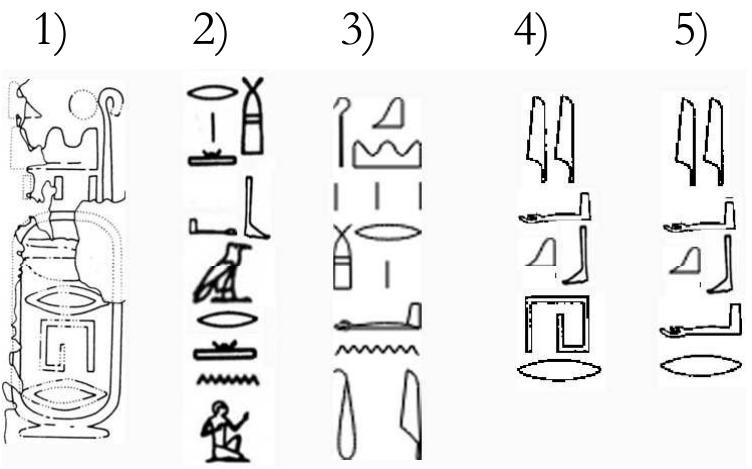
![ee 120 0 The ‘enthronement name: Sapait (s3 p3 ir) “son of the one who acted’, was attached shortly after the death of Seqenenre. Furthermore, the mummy of the prince measuring 1.17 m and his statue with a size of 1.035 m, it had to be done about 1 year before his death. As one can see, there are many anomalies, to say nothing of weirdness: 1) How does it happen that Seqenenre, the penultimate king of the 17" dynasty, discusses with Apopi, the last king of the 15" dynasty, while we should have a Theban king from the end of the 16" dynasty? Why a pharaoh is shocked that another Pharaoh do worship only one god''’? What contained so serious the letters of challenge from pharaoh Apopi that they could burst into tears, in great despair, pharaoh Seqenenre? The Challenoe "the hippos from the Southern City [Thebes] make noise" Gvhich is](https://figures.academia-assets.com/34352829/figure_008.jpg)


![164 |, COTELLE-MICHEL — Présentation préliminaire des blocs de la chapelle de Sésosttis I in: Cahiers de Karnak 11 (2003) p. 348. 105 M. WIENER, J.P. ALLEN Separate Lives: The Ahmose Tempest Stela and the Theran Eruption in: Near Eastern Studies 57 (1998) 1 pp. 1-28. provides insignificant information. Another graffito' carved on a block of a chapel at Karnak simply says this: In year 5, II Akhet 12, level of the great inundation. The chancellor of the king of Lower Egypt and general in chief Ah[mose] came. The most surprising information that Ahmose gave about the Hyksos period, which preceded his reign, comes from the “stele of the storm” or “Tempest Stele” dated year 1 (line 0). A high resolution readout made it possible to restore almost all of this stele’:](https://figures.academia-assets.com/34352829/figure_012.jpg)

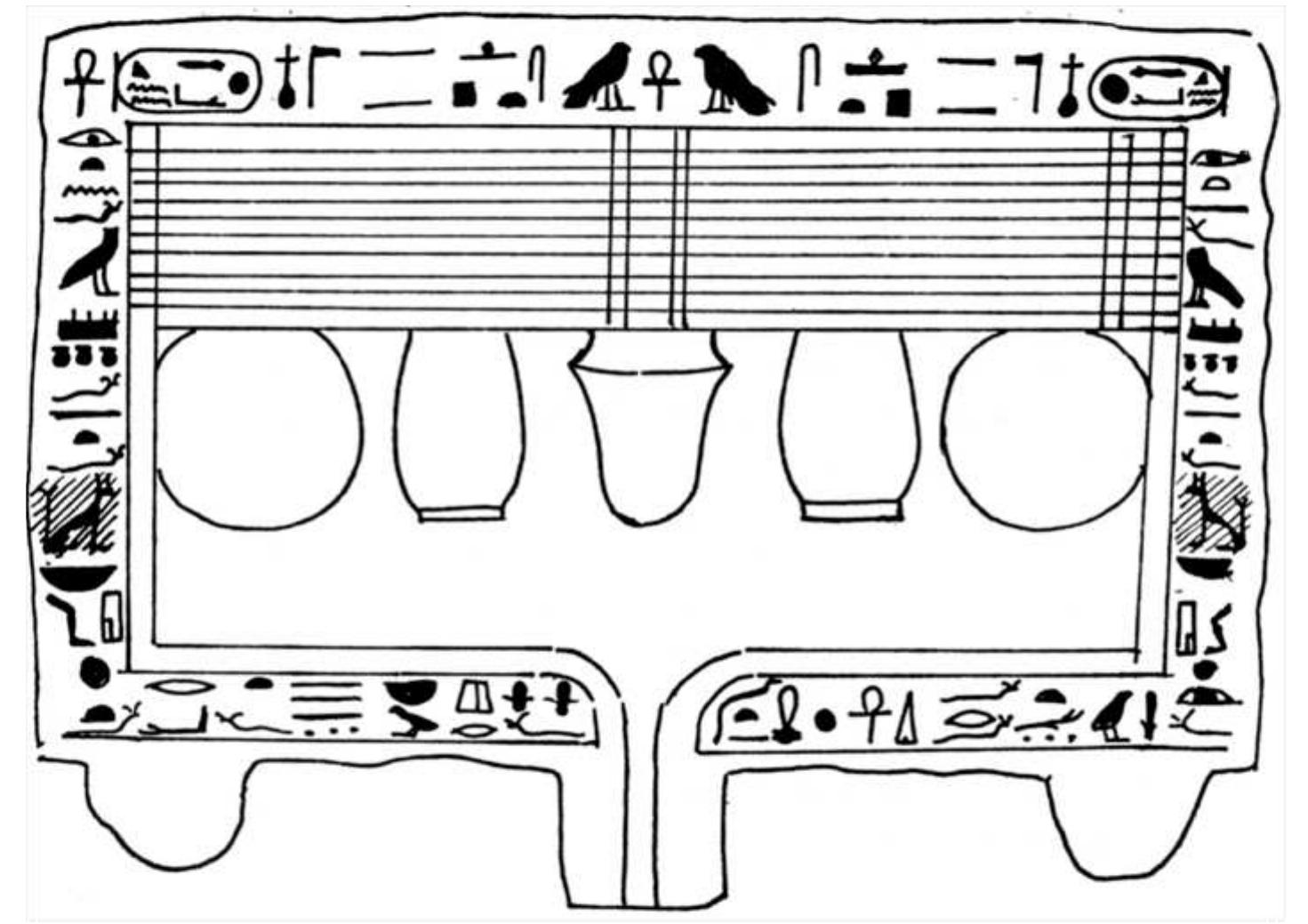

![Chronological information from the biblical text (death of Pharaoh dated May 10, 1533 BCE), from Josephus (14 Nisan = 14 Pharmouthi around 1530 BCE), from the Rhind papyrus (Avaris evacuated during I Shemu 1533 BCE) and from astronomy (total solar eclipse on May 10, 1533 BCE) coincide remarkably well: agitated and began to rock. Through the sea your way was, and your path was through many waters; And your very footprints have not come to be known. You have led your people just like a flock, by the hand of Moses and Aaron (Psalms 77:17-20). The text of Ezekiel mentions the tragic end of a pharaoh and associates it with a cloudy sky and a solar eclipse: Son of man, lift up a dirge concerning Pharaoh the king of Egypt, and you must say to him: As a maned young lion of nations you have been silenced. And you have been like the marine monster in the seas [crocodile], and you kept gushing in_ your rivers and Rept muddying the waters with your feet and fouling their rivers (...) And when you get extinguished I will cover [the] heavens and darken their stars. As for [the] sun, with clouds I shall cover tt, and [the] moon itself will not let its light shine. All the luminaries of light in the heavens — I shall darken them on your account, and I will put darkness upon your land (Ezekiel 32:2, 7-8). This text targets the Pharaoh of the Exodus, the only one known for ending tragically (Psalms 136:15), because the terms "crocodile dragon/ marine monster" always refer to this ruder (Isaiah 51:9-10) as an avatar of the sliding snake, Leviathan (Isaiah 27:1, Ezekiel 29:2-5, Psalms 74:13-14) and not Apries, the Pharaoh of that time who, him, is named (Jeremiah 44:30). This process of assimilation between two rulers from different eras is found again with the king of Tyre who was assimilate to the original serpent in Eden (Ezekiel 28:12-14). The expression: A/ the luminaries of light in the heavens — I shall darken them on your account, and I will put darkness upon your land has a symbolic meaning, but could be understood only if it had also a literal meaning. The Pharaoh was considered a living god by the Egyptians, the son of Ra the sun god, thus the solar eclipse as the moonless night had to mark them. According to astronomy, the only total solar eclipse in this region during this period 1600-1500°" was the one dated May 10, 1533 BCE™*) magnitude 1.08, it covered a strip of](https://figures.academia-assets.com/34352829/figure_016.jpg)


![According to the Pithom stele”, found in the same region (Tell Maskhuta) and dated the year 22 of Ptolemy II Philadelphus [in 263 BCE], one treads”: The King went to the province of Syria. When he reached Palestine, he found all the gods of Egypt and brought them back to The first inscription was found in El-Arish™’, and as noted by Griffith”, this long text refers to the ancient sanctuary of Pi-Soped (which was the capital of the 20" nome during the Ptolemaic period) and described in mythological terms the successive reigns of the gods Ra, Tefnut, Geb and Chou (description influenced by Greek conception of the four elements, Fire being associated with Ra, Tefnut with the Water, Geb with the Earth and Chou with the Air). Despite this theological aspect”, Goyon™’, the author of a complete translation of this text, has rightly noted: The story of the attack is based on the memories of invasions from the east and, in particular, the Hyksos invasion. The inhabitants of pi- Soped (p7-Spdw) were aware of being the bulwark of Egypt, or the other major city of the 20" nome was Gesem*”®’ (gsm is vocalized gosem in Coptic and gosen in Hebrew) which appears in "Land of Gesem" of the Septuagint. The word gasmou, which gesem is derived has the meaning of "storm" in Egyptian~’ (the word gi has the same meaning in Ugaritic and Hebrew). The terms "land of Goshen", "land of Rameses" and "Field of Tanis" mean essentially the same region (Genesis 45:10; 47:11, Psalms 78:12,43), or the land of the "Storm" belonging to the" Son of the Sun (Phataoh)" in the "marshlands of Tanis~*."](https://figures.academia-assets.com/34352829/figure_019.jpg)


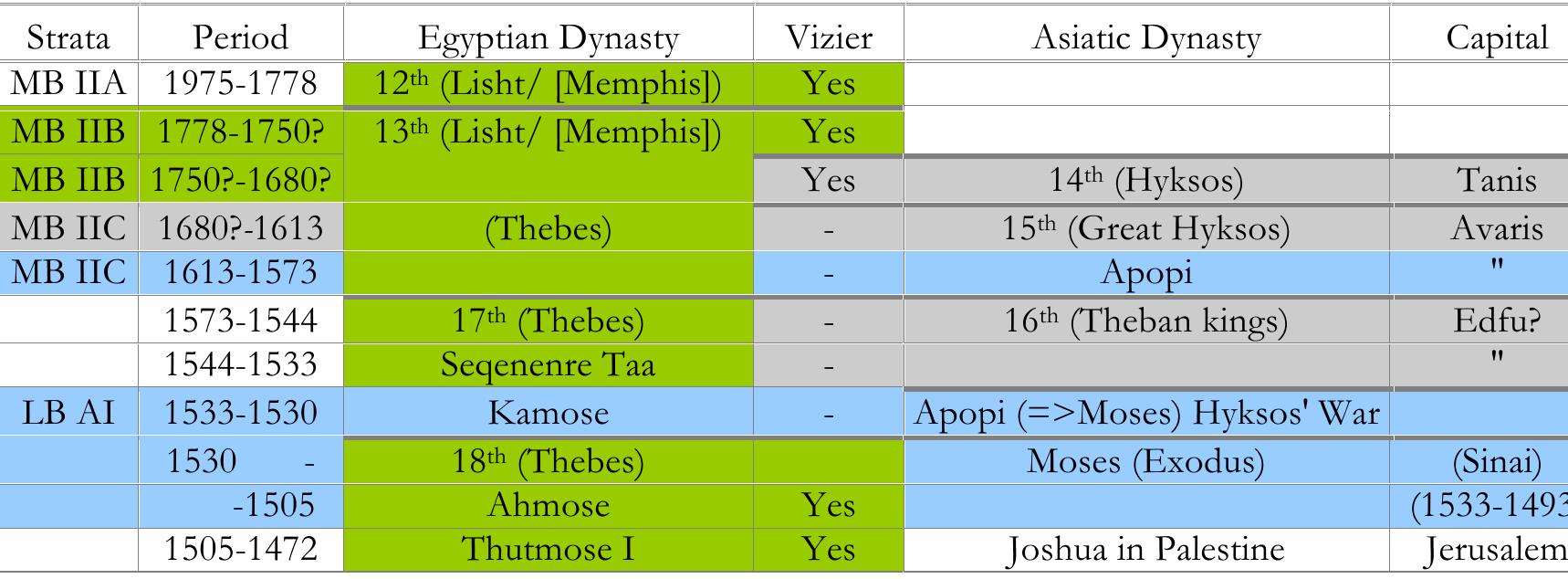
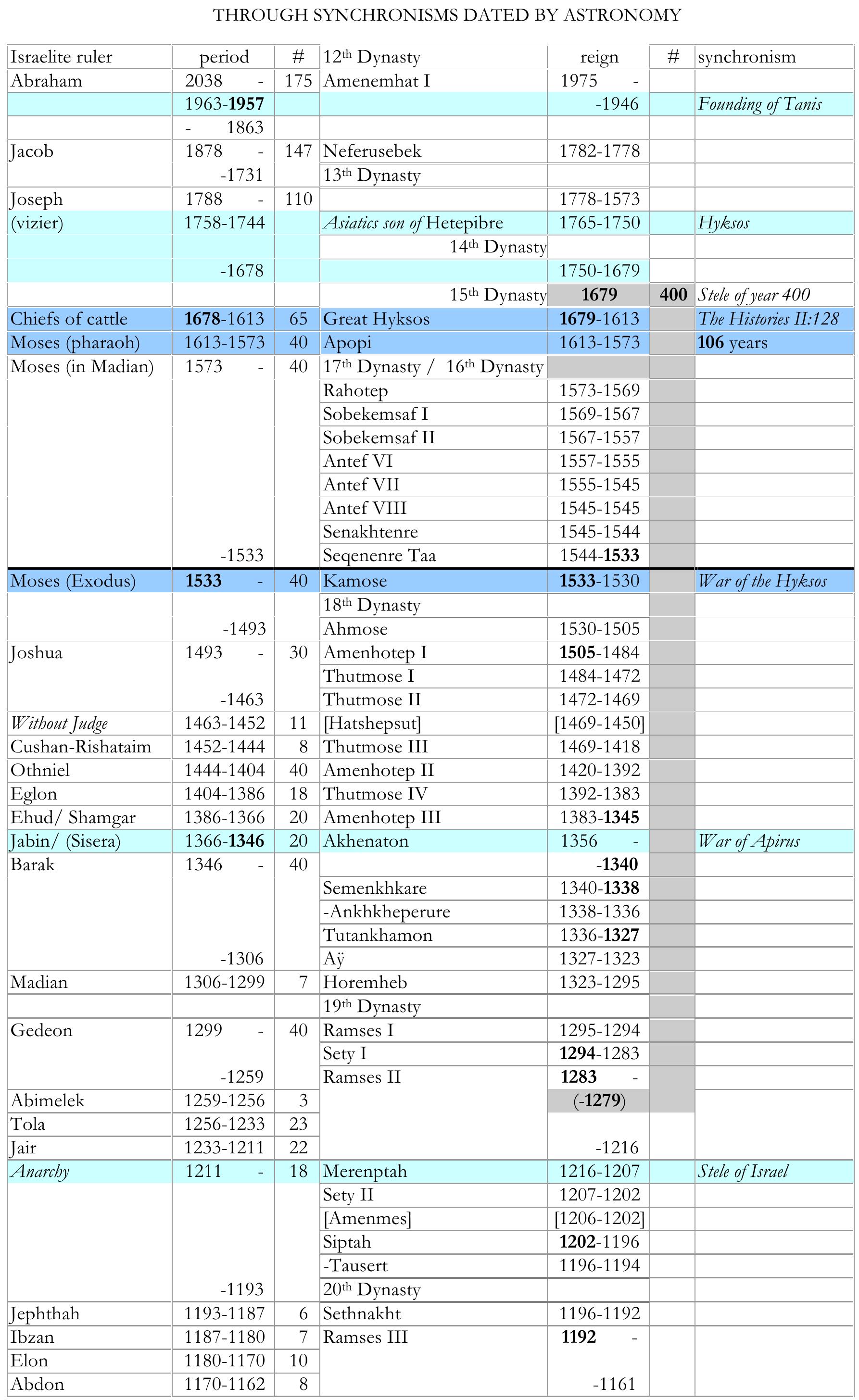
![Chronological reconstruction of the Second Intermediate Period is very uncertain, cluding the succession of kings”, it is based on the following elements: Sehet-Da‘aw "Field of Tanis", the same expression as in Psalm 78, which appears in the sequence /Sht/-D‘w (Fields of Tanis), Hwt-w'rt (Avaris), Rhty (?). It is precisely the same sequence: Sht+D (n), Hwt-w'rt, Rh that we find in the geographical procession in Ramses I's temple. The 400 Year Stela, found at Tanis, is a large slab of stone erected (c. 1280 BCE) by Ramses II to commemorate the 400" anniversary of the establishment of the reign of the god “Seth, Great of Power, the Ombite (the Baal or "Lord" of the Hyksos)”. A paleographical study of the name D‘(z)” shows that this toponym must go back to the end of the Old Kingdom”. The city of Tanis was founded at the beginning of the 12 dynasty because the statues of almost all the sovereigns of this dynasty, including Amenemhat I, remained there in that city. However, apart from the doorways erected in Bubastis, Khatana and Wadi Natrin, Amenemhat did not leave any other buildings in the Delta”. From an inscription unearthed in Khatana, alongside a statue depicting Amenemhat sitting, it is clear that the king was responsible for erecting a building here to which the door gave entrance. In addition one of the officials who lived under the reign of Amenemhat made a stela in which the 3™ line reads: year 20/? under] the majesty of... that enables us to date the building in 1957 BCE. Seeing that the doorway is still in its original place and that during the reign of Amenemhat I and Senusret III who were concerned with the doorway, the district was flourishing. Given that the doorway is still lying near its original place, we can suppose it was the same for Tanis where there was also a statue depicting Amenemhat I sitting. The few buildings built by Amenemhat I in the Delta were made to win the sympathy of the people in this region because of the prophecy of Neferty**. The famous prophecy of Neferty could be related to the 400-year prophecy given to Abraham: Then He [God] said to Abram: Know for certain that your offspring will be foreigners in a land not theirs and that the people there will enslave them and afflict them for 400 years. But I will judge the nation they will serve, and after t that they will & out with many foods (Genesis 15:13- 14). ge er i | a a: es ee](https://figures.academia-assets.com/34352829/table_002.jpg)

![There is no consensus to precisely restore the chronology of the 15" Dynasty, with the exception of Apopi, its last Hyksos king, who is well attested and reigned about 4[1] years” according to the Turin king-list. The Khyan sealings found at Edfu, in the same context together with those of Sobekhotep IV (1686-1677), attest a (non-violent !) contact between the Hyksos (15" Dynasty) and Upper Egypt” (13 Dynasty) at that time. Many kings not listed in the Turin King-list are difficult to classify among the five dynasties of the Second Intermediate Period (XHI to XVII), including those who are considered misclassified. King Aasehre Nehesy, for example, belonging to the 14 dynasty, is attested by several documents unearthed at Tanis, Tell el-Moqdam, Bubastis, Tell el- Daba (Avaris) and Tell el-Hebua (Tjaru) and King Mentuhopeti Seankhere, belonging to the 16" dynasty, is attested by two big sphinxes, unearthed at Edfu, and a fragmentary stele found at Karnak on which it is written: /Ring/ beloved by his army, his authority is strong; decisions which one lives (...) to submit all foreign countries (...) 1 am a king before Thebes, this my city, mistress of the whole country, the victorious city (...) more than any other city’. The sentence “submit all foreign countries” seems to refer the Asiatics residing in Egypt.](https://figures.academia-assets.com/34352829/table_004.jpg)
![The link between Old Canaanite and Old Hebrew is badly known because of the low number of documents. In addition, some words believed to be recent, because of their apparent absence in ancient documents (several examples arisen)™, existed in fact for many centuries, but had "hibernated*". Old Canaanite is very old as Unas' pyramid already contains, toward 2300 BCE, some sentences in this language written phonetically with hieroglyphs”. The fact that Egyptians loaned Canaanite words proves that there were many Canaanite inhabitants in Egypt from a remotest antiquity. The word migdol (Exodus 14:2), for example, magdalu in old Canaanite (letter EA 234), has been borrowed by the Egyptians toward 1800 BCE”. The word manna "what? (Exodus 16:15)" is different from Hebrew mé- hu "what [is] it" some scholars have explained this discrepancy by a popular etymology based on the Syriac or late Aramaic. This erudite explanation is inaccurate because, in both languages, the word manna means "who" and not "what". The form of the interrogative pronouns in ancient Semitic languages”, is: The word manna existed in Old Canaanite and meant "what", it is written ma-an-na (vocalization preserved by the Septuagint and the New Testament) in a letter dated around 1350 BCE found in El-Amarna (EA 286). Old Canaanite is a kind of Old Hebrew tinged with Akkadian® (Old Canaanite lexicon with a Babylonian grammar), which was used by scribes (Semites) in their correspondence with Canaan (Old Canaanite gave way to Hebrew after 1100 BCE). The word hanikayw "his men of elite" in Genesis 14:14 is another example proving high antiquity of Old Hebrew. This hapax, which the exact meaning was not yet known long ago, was discovered in some Egyptian execration texts dated 1900-1800 to qualify "men of elite" who belonged to Canaanite rulers. This rare word” appears then for the last time, in a text found at Taanach dated 1500-1400. lA Cauwmwesstece fee OV] Ushio) 26 Gees lesemecsoees aepooldl La eeeiceee ch awiles ee](https://figures.academia-assets.com/34352829/table_005.jpg)


![Year 9, the majesty of the King of Upper and Lower Egypt Djeser-ka-Ra [Amenhotep J], living The first column seems to establish the list of celebrations attached to each luna: nonth of the year (Thoth, Hathor, Horus and Khonsu are lunar deities). This list was no: ixed since several variants appeat:](https://figures.academia-assets.com/34352829/table_019.jpg)

![The scribe of the papyrus Ebers has condensed his information, but the reading of the first and last line is astronomically exact, since the beginning of the document reads: Year 9 of Amenhotep I, III Shemu [civil], lunar day 9 [psd meaning lunar day 1] rising of Sirius, and at the end: Epiphi [III Shemu civil] is lunar Il Shemu 9 [Epoch replaces the word Shemu] rising of Sirius.](https://figures.academia-assets.com/34352829/table_021.jpg)
![The Ebers Papyrus would be an incomprehensible exception unless one assumes that this list of lunar and calendar months is actually a series of double dates. By comparing the lunar cycle of 25 years deducted from Louvre Papyrus 7848 on notices that the presence of two identical lunar month "Thot" occurs only at the beginning of the cycle. In this case the previous date should be: II Shemu 9 [Lunar]/ epagomenal - [civil] which is a problem since there is no correspondent month "epagomenal". Comparing the list of double dates papyrus Louvre 7848 shows that the one preceding the cycle of 25 years with a lunar Il Shemu is the pair: IT Shemu 9 [Lunar]/ 14 Shemu II [civil] corresponding to the pait: LI Shemu 1 [psdntyw]/ 6 Shemu IL [civil], 8 days earlier.](https://figures.academia-assets.com/34352829/table_022.jpg)
![Amenhotep I being dead on HI Peret 21 (accession of Thutmose I) and having reigned 20 years, 7 months [and x days], according to Manetho, the date of accession should either up to TV Shemu 25 (if x = 0), or HI Shemu to 26 (if x = 29). Therefore the III Shemu 14 belongs to the last month of the 9" year of his reign. Reign of Amenhotep I according to the lunar cycle:](https://figures.academia-assets.com/34352829/table_023.jpg)
![The Sothic rising, dated IV Peret 16 in year 7 of Senwosret I, can be dated around 1850 BCE by astronomy because at that time the Sothic rising took place July 11 in Thebes (longitude 32° 39' E, latitude 25° 42' N) and 15/16 July in Memphis (longitude 31° 15' E, latitude 29° 52' N), which fixes the heliacal rising of Sirius either in 1849 BCE +/- 4 years in Thebes or 1865 BCE +/- 4 in Memphis”. The arcus visionis should be 8.3° instead of 8.5° because around 1850 BCE the angle between the Sun and Sirius at its rising was a little higher than today. It is possible to refine this dating using numerous lunar dates” that span during the 19 years of the reign of Senwosret III, followed by the 45 years of Amenemhat HI and which fit according to the lunar cycle of 25 years (dates highlighted hereafter)’. They are offset by 1 day compared with those of Parker who translated the word "until" in an inclusive meaning and not exclusive’*. The few irregularities prove that it is observed ” The 19-year reign of Senwosret III precede the 45 years 330 cycles and not calculated cycles of Amenemhat I], his successor, without official co-regency](https://figures.academia-assets.com/34352829/table_024.jpg)


![Byblos Rulers at the time of these Egyptian kings being quite similar it can be assumed a petiod of about 25 years of reign (= 197/8). The historical sequence” is: 1) Abi-Shemu I (Tomb I), 2) Ipy-Shemu-Abi (Tomb II), 3) Yakin-el (Tomb III), a contemporary of Sihornedjherkef Hotepibre, and 4) Ilimi-Yapi (Tomb IV). Yatin-Ammu's father was Yakin. One can also assume that Neferhotep I was contemporary of Yantin-Ammu since was found at Byblos a relief showing Pharaoh Neferhotep I°” opposite Prince Yantin-((Ammu) of Byblos. In addition, in a letter dated the 9" year of Zimri-Lim (1680-1667), king of Mati, the name Yantin-Ammu appears as the donor of a gold cup. The following chronological reconstruction shows that the agreement is good for +/- 10 years. Conspicuously few monuments of the 14° Dynasty are known today. The entire dynasty is represented by no more than about ten royal monuments and, except for two, all bear the name of Nehsy (either as king or king's son) who had a reign of less than one year according to the Turin King-list. This circumstance is difficult to reconcile with the fact that the 14" Dynasty was situated in the most fertile lands in Egypt and had intensive trade with both Canaan, Thirteenth Dynasty Egypt, and Nubia. Apart from scarabs and a few seal-impressions, the 14° Dynasty is attested outside the Turin King-list only by monuments of its second king, Nehsy, from the eastern Delta, none of which was found in precisely datable contexts. For its 51 or more rulers, the King-list preserves a total of 12 years, 2 months, and 23 days of rule in 18 entries, with no reign longer than three years” (the five first rulers are lost). Thus the total duration of the 14 dynasty should be about 34 yeats (= 51x12/18). Several reigns have durations of only a few months which shows abnormal process. The first Asiatic king had to appear at the time of Hotepibre™' under the prenomen "the Asiatics, son of Hornedjherkef", Hornedjherkef (1753-1741) being a king of the 13" Dynasty. The last king of the 14 Dynasty had to coincide with the first king of the 15" Dynasty (the Great Hyksos)? According to the Jewish historian Artapan (around 200 BCE) quoted by Eusebius (Preparatio Evangelica [X:27:3-5) the region above Memphis was divided into various kingdoms under Pharaoh [Sobekhotep IV] Chenephres (1690-1682). The information is accurate, because the royal activities during the 13" dynasty are attested until the end Sobekhotep IV's reign, the most prestigious king of this dynasty, further in the north of Thebes rather than Thebes itself.](https://figures.academia-assets.com/34352829/table_029.jpg)
![The 15th dynasty is better documented because its total duration is 10[8] years, according to the Turin King List or 106 years, according to Herodotus (The Histories II:128). The beginning of the dynasty is located towards Sobekhotep IV (1690-1682). The Stele of the year 400, made under Ramses I, apparently refers to the Sethian dynasty of the Great Hyksos, 400 years earlier. The Stele seems to have been made by Ramses to support an honourable affiliation with an ancient dynasty, because the cult of Seth, likened to the Baal of the Hyksos, was not widespread among the Egyptians. He seems to have connected](https://figures.academia-assets.com/34352829/table_030.jpg)


![land of Exgypt [and in the land of Canaan] was four hundred and thirty years long. This interpolation, that is also found in the Samaritan Pentateuch, is in keeping with the context which says that the 430-year period covers the total span of the painful dwelling of the sons of Israel outside the Mosaic covenant (Galatians 3:17). This period does include two parts: the first one starts in Canaan with the Abrahamic covenant rapidly followed by harassment of Isaac by Esau (Genesis 21:9), and ends when Jacob left for Egypt. The second one begins with the slavery in Egypt and terminates with the Exodus. The above verse should then be read as follows: And the dwelling of the sons of Israel, who had dwelt in Egypt [for 215 years], was 430 years long. Joshua's genealogy indirectly confirms this 215-year period (1Chronicles 7:23-28). Joshua was 40 years old when Israel fled Egypt (Joshua 14:7) in 1533 BCE. Then he should have been born about 1573 BCE. Assessing 20 years elapse between every generation, we get the following dates of birth: As Joseph was 17 years old when he came in Egypt (Genesis 37:2), the period of time from his marriage in -1758 (Genesis 41:45-46) to the Exodus in -1533 amounts to 225 years (= 1758 — 1533), which are fully consistent with the 215 years that have just been calculated. This chronological point was known in antiquity, since Josephus (Jewish Antiquities I1:318) refers to it in its works. Demetrius, already knew (around 220 BCE) that the period in Canaan lasted 215 years (Prepraratio evangelica [X:21:16). The biblical chronology therefore sets rather precisely the date of the Exodus from Egypt in -1533.](https://figures.academia-assets.com/34352829/table_035.jpg)


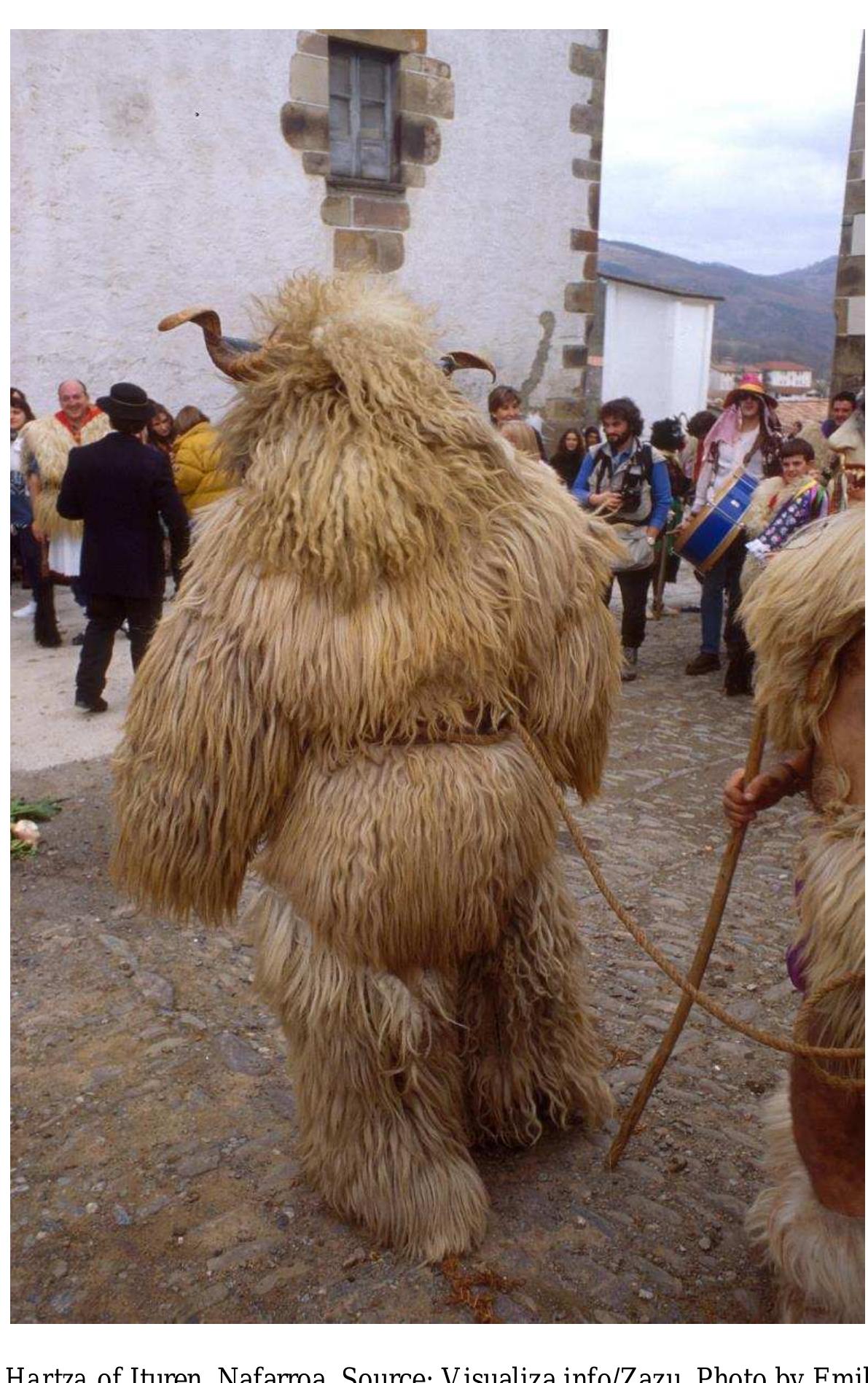




![Pyrenees at Sainte-Engrace [Santa Garazi], in the province of Soule [Zuberoa] in Euskal Herria [Basque Country].) (Peillen, 1986: 171)°](https://figures.academia-assets.com/44607906/figure_016.jpg)




![[...] the word does not forget where it has been and can never wholly free itself from the dominion of the contexts of which it has been part. E-mail: roz-frank@ uiowa.edu Roslyn M. Frank University of Iowa ‘-—mail: roz-frank®@ 110wa2.ed](https://figures.academia-assets.com/44607906/figure_025.jpg)


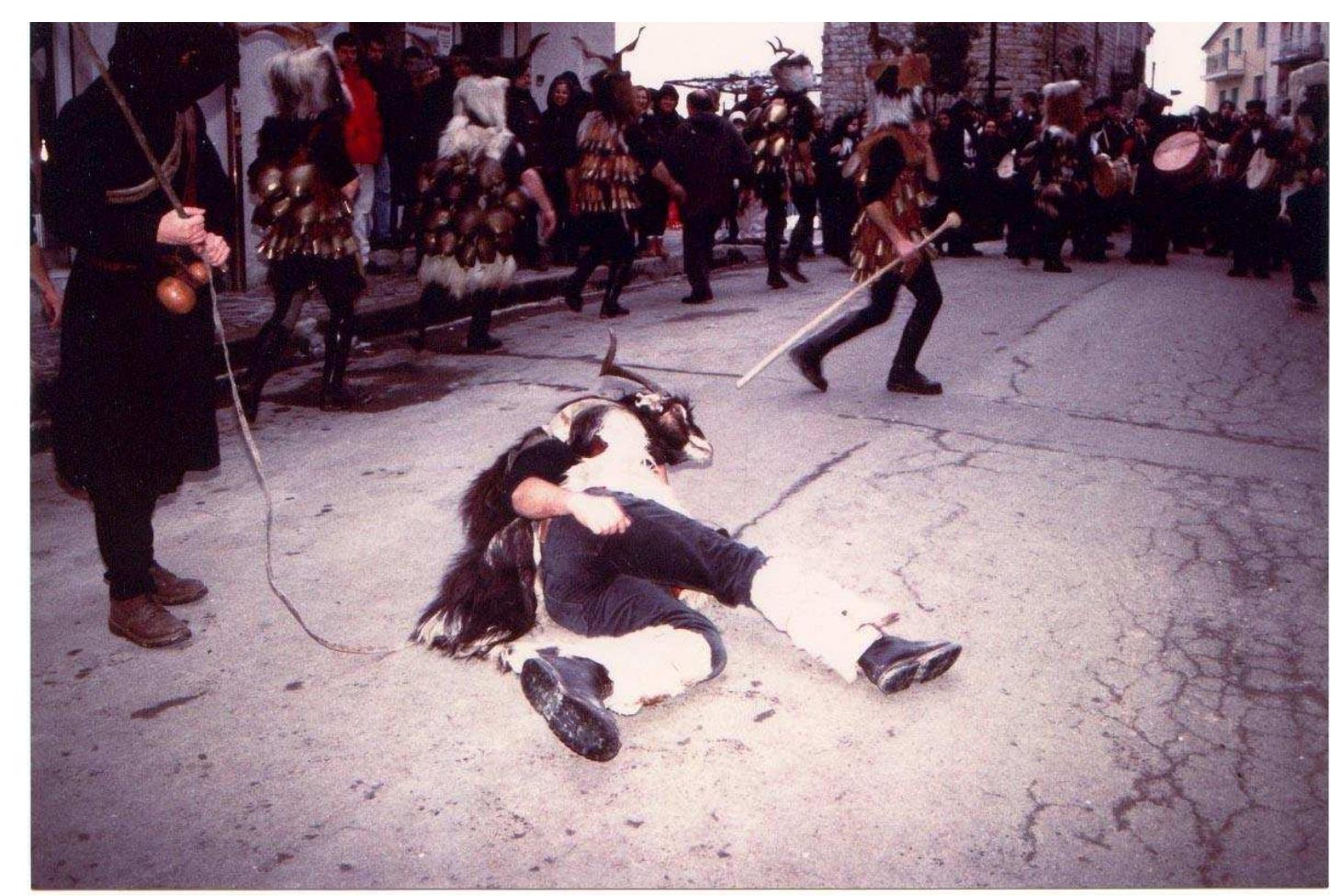
![Figure 1. Names of the gift-bringers on St. Martin’s Day (November 11). Adapted from Erich and Beitl (1955: 509). For example, today in many parts of Europe on the saint’s day in question, November 11", an actor appears in the guise of the bishop St. Martin. But, more importantly, when the individual dressed as a bishop does appear, he continues, as before, to be accompanied on his rounds by a bear-like creature, his pagan double. In short, these ursine administrants, in recent times merely ordinary human actors, perform their duties authorized by a kind of Christian dispensation that permits them to continue to preside, quite discreetly, over the festivities (Miles [1912] 1976: 208). In tum the bishop in question takes over the role and attributes of the bear trainer through this process of symbolic hybridization. Thus, the meaning of the bishop’s companion, the masked figure representing the bear, is transparently obvious once one understands the mechanisms of hybridization involved in the renaming processes themselves.® In short, any attempt to discover the identity of the furry, often frightening, masked figures associated with St. Martin’s day must take these facts into account (Figure 1).](https://figures.academia-assets.com/44607906/figure_030.jpg)




![Fig. 12. St. Nicholas and his Servant - St. Nikolaas en zijn knecht by J. Schenkman]. Amsterdam: J. V lieger, [ca.1885]. Source: http://www.kb.nl/uitgelicht/kinderboeken/sinterklaas/sinterklaas-ill html.](https://figures.academia-assets.com/44607906/figure_041.jpg)


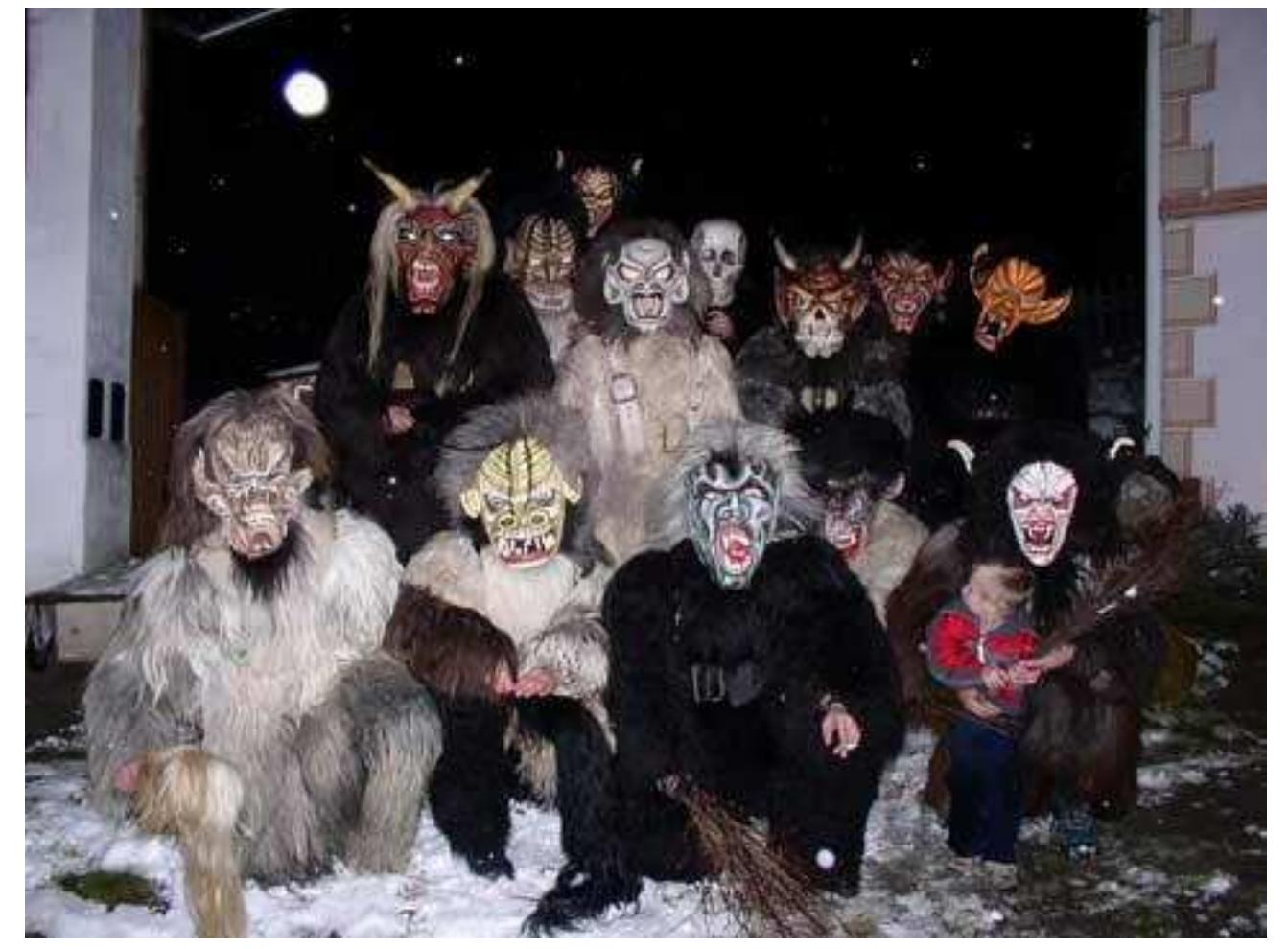
![Figure 16. St. Nikolaus with his companions in Berchtesgaden, Bavaria 1958. Photo Wolf Luking. Reproduced in Weber-K ellermann (1978: 33). Schimmelreiter enters first, followed by Christpuppe who makes the children repeat some verse of Scripture or a hymn; if they know it well, he rewards them with gingerbreads from his wallet; if not, he beats them with a bundle filled with ashes. Then both he and the Schimmelreiter dance and pass on. Only then are the Feien allowed to enter; they jump about and frighten the children (Miles [1912] 1976: 230-231) (Figures 16, 17, 18). Indeed, the ritual of smearing ashes on the faces of those encountered, as well as the fact that ashes form an integral part of the make-up of the performers themselves, are recurrent features of the performances. As such, the use of ashes may have been a fundamental component of the “good-luck” healing ceremonies themselves. There are many examples of the old European belief in the “good luck” conferred by ashes, blackening one’s face with them and black creatures in general (Alford 1930: 277 ff; Barandiaran 1973, II: 375; Creighton 1950: 20-21; Frank 2005b)](https://figures.academia-assets.com/44607906/figure_045.jpg)


![characters were absent.** Today the performers’ appearance is manipulated so as to make them appear extremely bulky, larger than life, similarto En Peirot of Catalunya, a characte! we will examine in more detail shortly. In order to achieve this effect, the actors stuff their costumes with straw, while the costumes themselves are made out of gunny sacks. As a result, the expression azaku-zaharrak ([Ihauteriak] 1992) has undergone further phonological erosion and semantic reanalysis, being reduced, at least by some writers, to zaku-zaharrak, and interpreted, erroneously, as meaning “sacos viejos” (“old sacks”) as if the first element corresponded to the old gunny sacks used to make the costumes. the first element corresponded to the old gunny sacks used to make the costumes. In summary, in the case of the compound hamalau-zaingo we find three intertwined meanings that, in turn, reveal three distinct yet interlocking aspects or characteristics that are closely associated with the entity in question. First, the phonologically eroded variants of hamalauzanko and hamalauzaku appear to be reflexes of the name of the official who was in charge of watching over the community and insuring that its norms and rules of conduct were observed; second, we note that it is the name assigned to the fantastic being invoked to make children behave; and finally, it shows up in the name of a bizarre bear- like masked performer, the hamalauzaku. Stitching these clues together we discover a cleat pattern, one that illuminates yet another dimension of the Hamalau cultural complex: that in all likelihood the individual who was in charge of watching over the community was also the individual who dressed in a particular fashion, not like the other members of the community, and was also expected to take an active part in public rituals, if not preside](https://figures.academia-assets.com/44607906/figure_050.jpg)
![Por los valles altos pirenaicos de la region leridana se habia acudido asimismo al oso, y en Andorra, asu hembra, la osa, mucho mas temible aun que éste. La representacion del oso danzarin habia sido muy frecuente en Carnaval; y, cual En Peirot 0 el Marraco, los nifos lo miraban con pavor, no como un fiero animal, sino en su condicion de traganifios traviesos. [In the high Pyrenean valleys of the region of Lérida, they have also resorted to the bear, and in Andorra, to the female bear, which is even more fearsome than the former. The representation of a dancing bear is very common during Carnival; and, like En Peirot or the Marraco, children looked at it with terror, not because it was as a wild animal, but rather because of its condition as a devourer of disobedient children.] (Amades 1957: 269-270)](https://figures.academia-assets.com/44607906/figure_051.jpg)


![Table 1 Certain and possible victors of the race for four-horse chariots at Olympia Most victors are known for the race of horses with rider: a) Nikagoras of Lindos in he late fourth or early third century; b) Pandion of Thessaly in 296 BC; c) Trygaios of in unknown city; d) Phylopidas of Thessaly; e) Amyntas of Thessaly; f) an unknown [hessalian who won three times — possibly identical with one of the three previous victors — all (c, d, e, f) during the career of Posidippus; g) M[...] of Crannon in [hessaly — also possibly to be identified with the unknown Thessalian — in 268 BC; und h) Pantarkes and i) Thrasonides, both of Elis, probably in the second half of the hird century. [31] Since the poem for Trygaios is incomplete, it is also possible that 1e won with a foal instead of with a full-grown horse. The race for foals with rider was introduced in 256 BC, when the victor was Hippokrates of Thessaly, according to Susebius’ victor list, or Tlepolemos of Lycia, according to Pausanias. [32] They »srobably both won a victory in this olympiad, perhaps in the race for full-grown 1orses and in the race for foals. One of the authors made a mistake while selecting nformation. Eusebius’ list is generally the more trustworthy source, but since the ntroduction of the new event is only mentioned in the Armenian version, not in the Sreek manuscript, this argument should not be pressed. No Ptolemaic roval victors are known outside the four-horse chariot races. At](https://figures.academia-assets.com/47546825/table_001.jpg)