Preface Throughout all of Europe we find examples of folk-belief assigning special qualities to the seventh-born son or daughter of a family. At times these attributes were positive, at times negative. However, they always had a magical...
morePreface
Throughout all of Europe we find examples of folk-belief assigning special qualities to the seventh-born son or daughter of a family. At times these attributes were positive, at times negative. However, they always had a magical aura about them (Bloch [1924] 1983). For the most part, these beliefs have been written off as superstitious residue from times past and as a result little attention has been paid to documenting the concrete social practices associated with them. An exception to this tendency is the work of Marc Bloch, who in 1924, called attention to the supernatural powers attributed to the seventh son and at times, to the seventh daughter, born after an uninterrupted series of the same sex, remarking that seventh-born children were credited with a “particular supernatural power” (Bloch [1924] 1983: 293, 296). Writing in 1924, Bloch observed that “La croyance sous cette forme a été et est sans doute encore très largement répandue dans l’Europe occidentale et centrale: on l’a signalée en Allemagne, en Biscaye, en Catalogne, dans presque toute la France, dans les Pays-Bas, en Angleterre, en Escosse, en Irlande […]” (Bloch [1924] 1983: 294-295).
Specifically, Bloch noted that from at least the 16th century onwards, children born into a seventh position in their family supposedly had the power to heal by touch. Such extraordinary people, often deemed sorcerers, even devils, were also referred to by a variety of expressions such as mahr (German) or murawa (Polish) and consequently they had the ambivalent privilege of tapping into powers that were inaccessible to normal humans. Specifically, they were viewed as having healing and divinatory powers, which could entail shape-shifting (Vaz da Silva 2003). That is, those individuals were endowed with the ability to take the form of an animal. From the point of view of modern Western thought this belief causes the dividing line between humans and animals to become blurred. Nonetheless, that blurring or fusion of two natures would be in accordance with the cosmology of native peoples in other parts of the world, especially contemporary hunter-gatherers, where such animistic beliefs also prevail (Bird-David 1999; Brightman 2002; Ingold 2000; Willerslev 2007).
It is quite clear that the qualities assigned to the seventh-son or daughter harken back to an earlier animistic mindset, notions of nonhuman personhood and social practices that in turn connect back to shamanic modes of healing. At the same time, as noted in the earlier chapters of this study, the fused nature of the Bear Son, the half-human, half-bear being known as Hamalau “Fourteen” in Basque, reflects a similar blurring of the Western human-animal divide and related cultural conceptualizations.
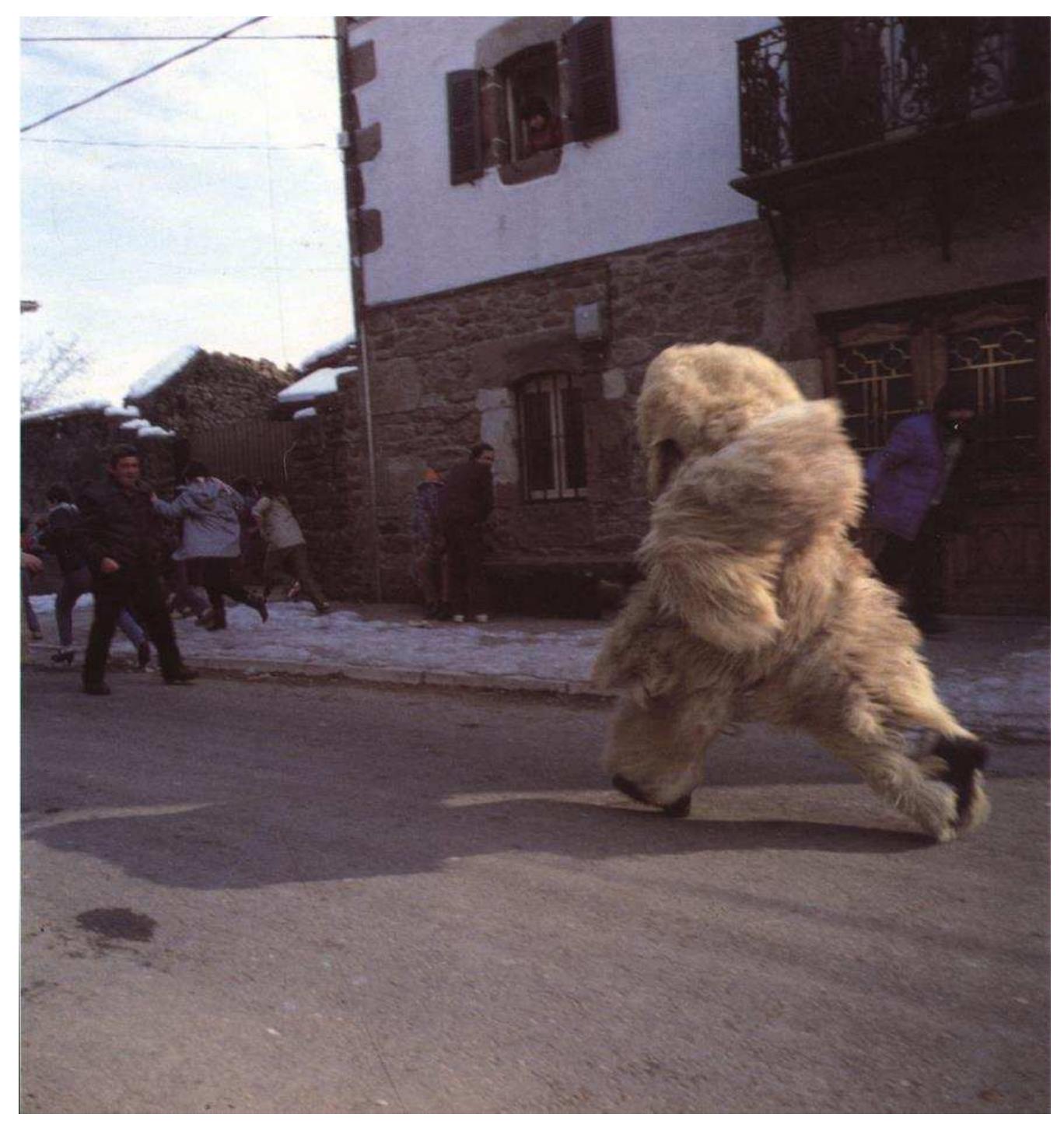
And as Bertolotti has demonstrated in his detailed and extraordinarily well researched study Carnevale di Massa 1950 (1992), European versions of the Bear Son folktales, e.g., Giovanni l’Orso, may well reproduce much earlier beliefs, more in consonance with the cosmovision of hunter-gatherers who inhabited these zones in times past. More concretely, the fact that the figure of Hamalau is grounded in the belief that humans descended from bears allows us to consider the significance and symbolism of this character’s own genesis: he is born of a human female, but his father is a bear. In this sense, he is a double-natured intermediary occupying the ontological ground between humans and bears.

















![Pyrenees at Sainte-Engrace [Santa Garazi], in the province of Soule [Zuberoa] in Euskal Herria [Basque Country].) (Peillen, 1986: 171)°](https://figures.academia-assets.com/44607906/figure_016.jpg)




![[...] the word does not forget where it has been and can never wholly free itself from the dominion of the contexts of which it has been part. E-mail: roz-frank@ uiowa.edu Roslyn M. Frank University of Iowa ‘-—mail: roz-frank®@ 110wa2.ed](https://figures.academia-assets.com/44607906/figure_025.jpg)


![Figure 1. Names of the gift-bringers on St. Martin’s Day (November 11). Adapted from Erich and Beitl (1955: 509). For example, today in many parts of Europe on the saint’s day in question, November 11", an actor appears in the guise of the bishop St. Martin. But, more importantly, when the individual dressed as a bishop does appear, he continues, as before, to be accompanied on his rounds by a bear-like creature, his pagan double. In short, these ursine administrants, in recent times merely ordinary human actors, perform their duties authorized by a kind of Christian dispensation that permits them to continue to preside, quite discreetly, over the festivities (Miles [1912] 1976: 208). In tum the bishop in question takes over the role and attributes of the bear trainer through this process of symbolic hybridization. Thus, the meaning of the bishop’s companion, the masked figure representing the bear, is transparently obvious once one understands the mechanisms of hybridization involved in the renaming processes themselves.® In short, any attempt to discover the identity of the furry, often frightening, masked figures associated with St. Martin’s day must take these facts into account (Figure 1).](https://figures.academia-assets.com/44607906/figure_030.jpg)




![Fig. 12. St. Nicholas and his Servant - St. Nikolaas en zijn knecht by J. Schenkman]. Amsterdam: J. V lieger, [ca.1885]. Source: http://www.kb.nl/uitgelicht/kinderboeken/sinterklaas/sinterklaas-ill html.](https://figures.academia-assets.com/44607906/figure_041.jpg)


![Figure 16. St. Nikolaus with his companions in Berchtesgaden, Bavaria 1958. Photo Wolf Luking. Reproduced in Weber-K ellermann (1978: 33). Schimmelreiter enters first, followed by Christpuppe who makes the children repeat some verse of Scripture or a hymn; if they know it well, he rewards them with gingerbreads from his wallet; if not, he beats them with a bundle filled with ashes. Then both he and the Schimmelreiter dance and pass on. Only then are the Feien allowed to enter; they jump about and frighten the children (Miles [1912] 1976: 230-231) (Figures 16, 17, 18). Indeed, the ritual of smearing ashes on the faces of those encountered, as well as the fact that ashes form an integral part of the make-up of the performers themselves, are recurrent features of the performances. As such, the use of ashes may have been a fundamental component of the “good-luck” healing ceremonies themselves. There are many examples of the old European belief in the “good luck” conferred by ashes, blackening one’s face with them and black creatures in general (Alford 1930: 277 ff; Barandiaran 1973, II: 375; Creighton 1950: 20-21; Frank 2005b)](https://figures.academia-assets.com/44607906/figure_045.jpg)


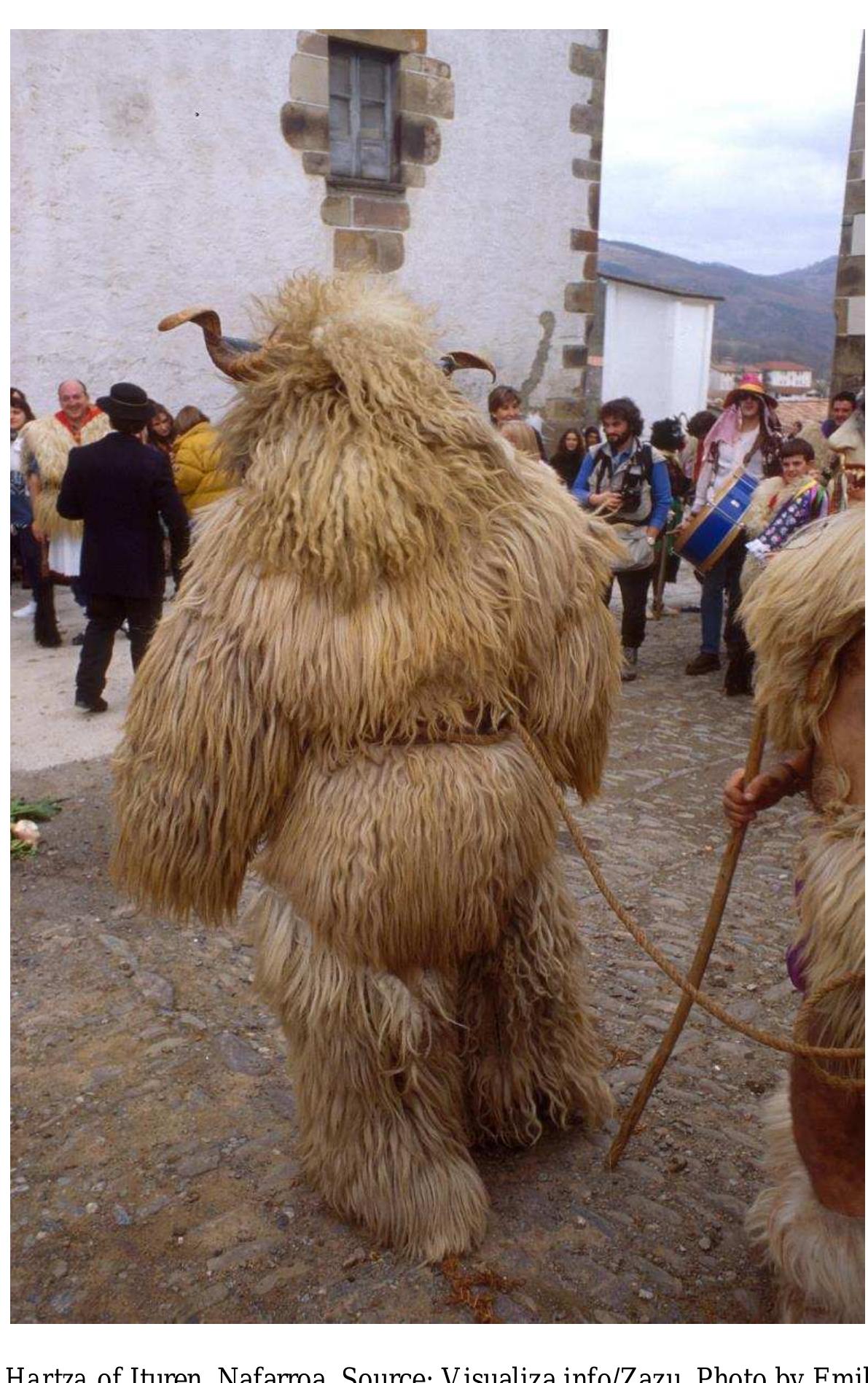
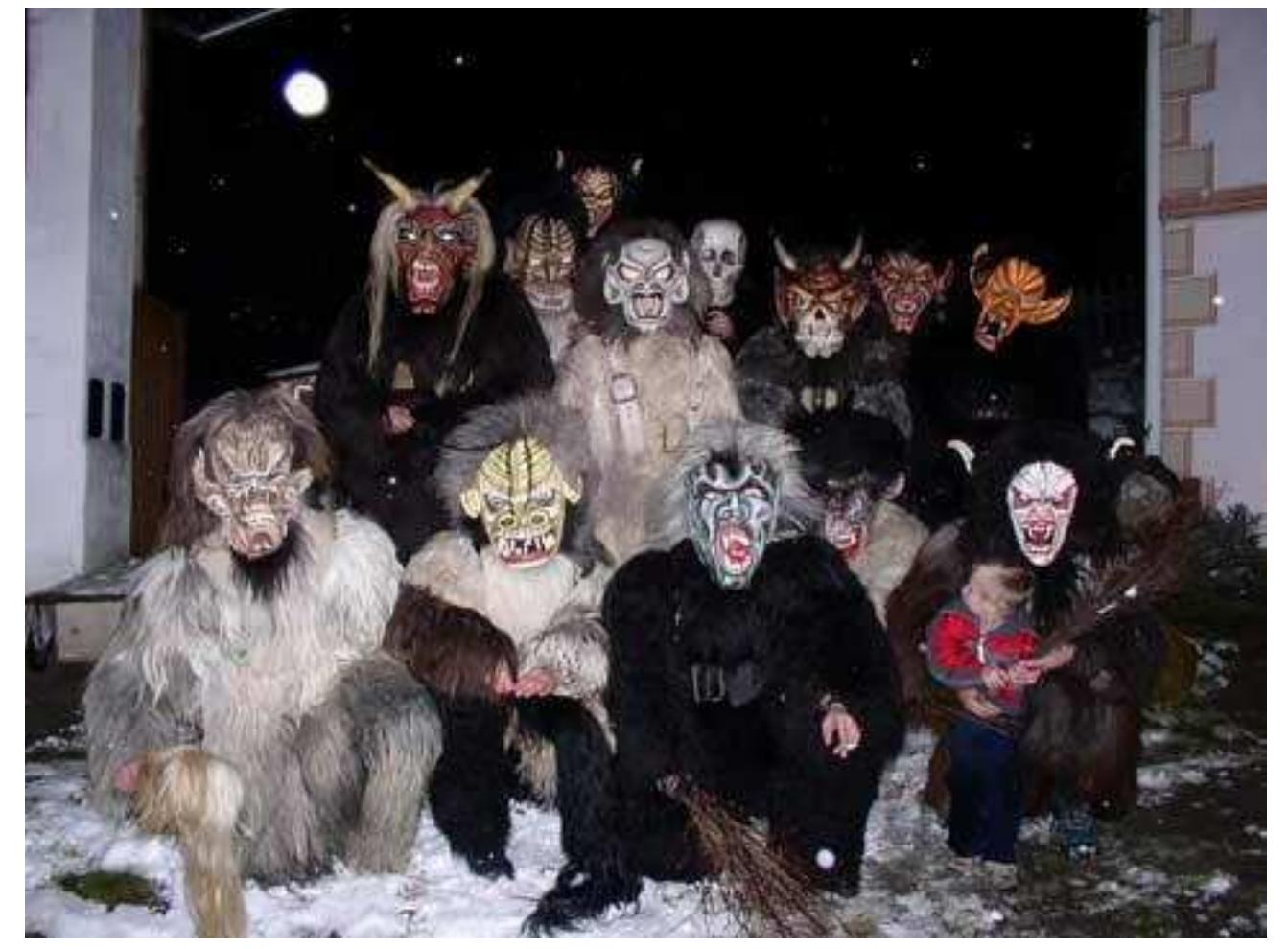
![characters were absent.** Today the performers’ appearance is manipulated so as to make them appear extremely bulky, larger than life, similarto En Peirot of Catalunya, a characte! we will examine in more detail shortly. In order to achieve this effect, the actors stuff their costumes with straw, while the costumes themselves are made out of gunny sacks. As a result, the expression azaku-zaharrak ([Ihauteriak] 1992) has undergone further phonological erosion and semantic reanalysis, being reduced, at least by some writers, to zaku-zaharrak, and interpreted, erroneously, as meaning “sacos viejos” (“old sacks”) as if the first element corresponded to the old gunny sacks used to make the costumes. the first element corresponded to the old gunny sacks used to make the costumes. In summary, in the case of the compound hamalau-zaingo we find three intertwined meanings that, in turn, reveal three distinct yet interlocking aspects or characteristics that are closely associated with the entity in question. First, the phonologically eroded variants of hamalauzanko and hamalauzaku appear to be reflexes of the name of the official who was in charge of watching over the community and insuring that its norms and rules of conduct were observed; second, we note that it is the name assigned to the fantastic being invoked to make children behave; and finally, it shows up in the name of a bizarre bear- like masked performer, the hamalauzaku. Stitching these clues together we discover a cleat pattern, one that illuminates yet another dimension of the Hamalau cultural complex: that in all likelihood the individual who was in charge of watching over the community was also the individual who dressed in a particular fashion, not like the other members of the community, and was also expected to take an active part in public rituals, if not preside](https://figures.academia-assets.com/44607906/figure_050.jpg)
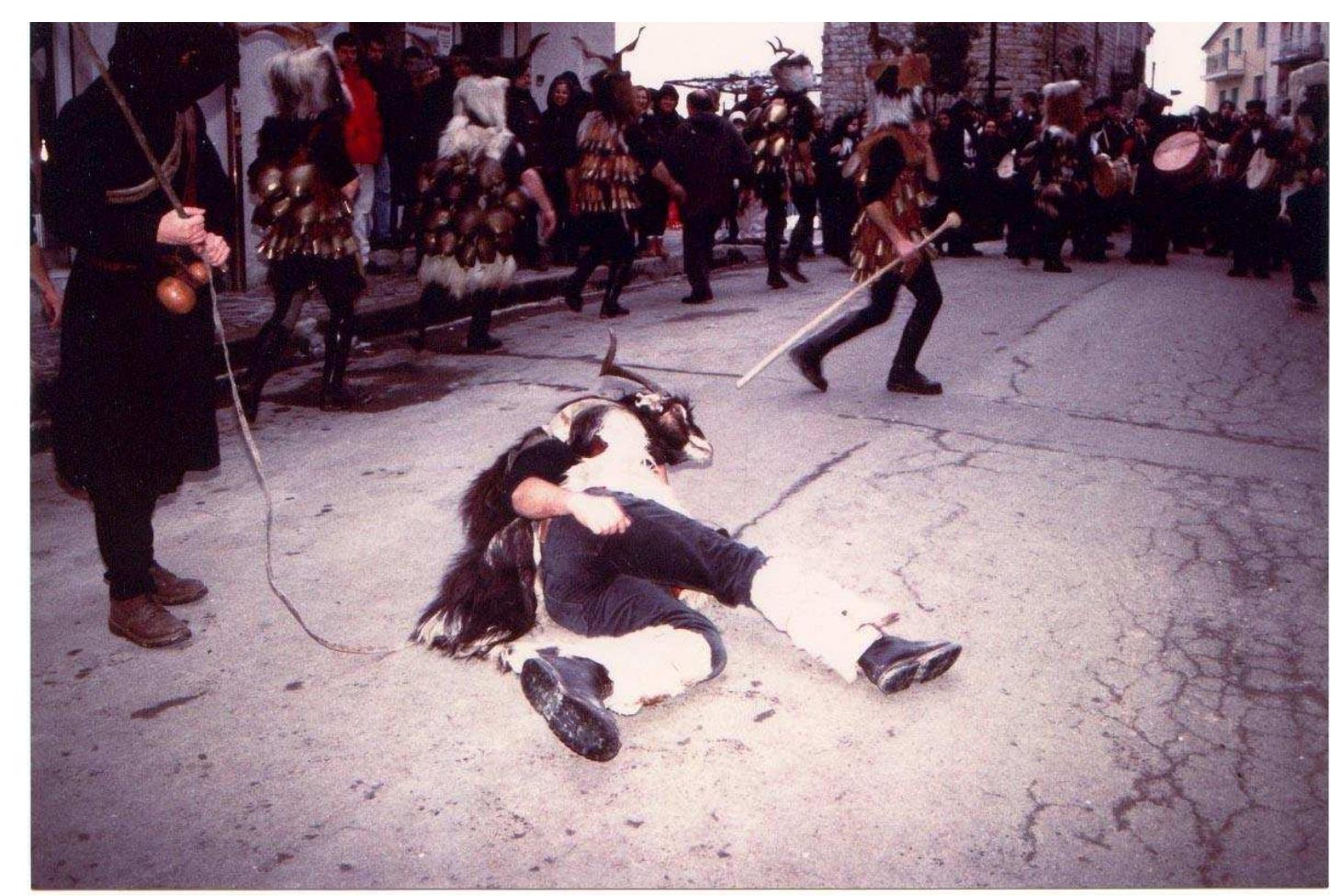
![Por los valles altos pirenaicos de la region leridana se habia acudido asimismo al oso, y en Andorra, asu hembra, la osa, mucho mas temible aun que éste. La representacion del oso danzarin habia sido muy frecuente en Carnaval; y, cual En Peirot 0 el Marraco, los nifos lo miraban con pavor, no como un fiero animal, sino en su condicion de traganifios traviesos. [In the high Pyrenean valleys of the region of Lérida, they have also resorted to the bear, and in Andorra, to the female bear, which is even more fearsome than the former. The representation of a dancing bear is very common during Carnival; and, like En Peirot or the Marraco, children looked at it with terror, not because it was as a wild animal, but rather because of its condition as a devourer of disobedient children.] (Amades 1957: 269-270)](https://figures.academia-assets.com/44607906/figure_051.jpg)


![Figure 10.1 Distribution of children according to the number of correctly read words in the L1 These results show that some bilinguals were not familiar with the graphemes anc words of their native language (7 DfB, 11 FdB), while others were (12 DfB, 15 FdB). Only the results of these two last subgroups were considered in further ana- lyses. However, the results of 4 of the FdB could not be considered because they were not presented with the homographs and related items in their Ll] due tc absenteeism or lack of time. Therefore, only the results of 12 DfB and 11 FdB were considered in further analyses. Their average percentage of correct responses for the specific graphemes of their L1 were 68 and 70 per cent, and 90 and 88 per cent for the related words, respectively. ™4Tm1 a Ty Aan ™mrm . 1 1c 1s me =@ a oe 1](https://figures.academia-assets.com/34618392/figure_014.jpg)




![Figure 1.1]. A representation of the cyclical relationship between internal- ization and externalization at different points in an expansive cycle of changing activity.](https://figures.academia-assets.com/36965097/figure_009.jpg)