This dissertation examines the military and social roles of centurions in the Roman legions during the Republic and Principate. It combines textual accounts of centurions from such authors as Caesar, Tacitus, and Cassius Dio, as well as...
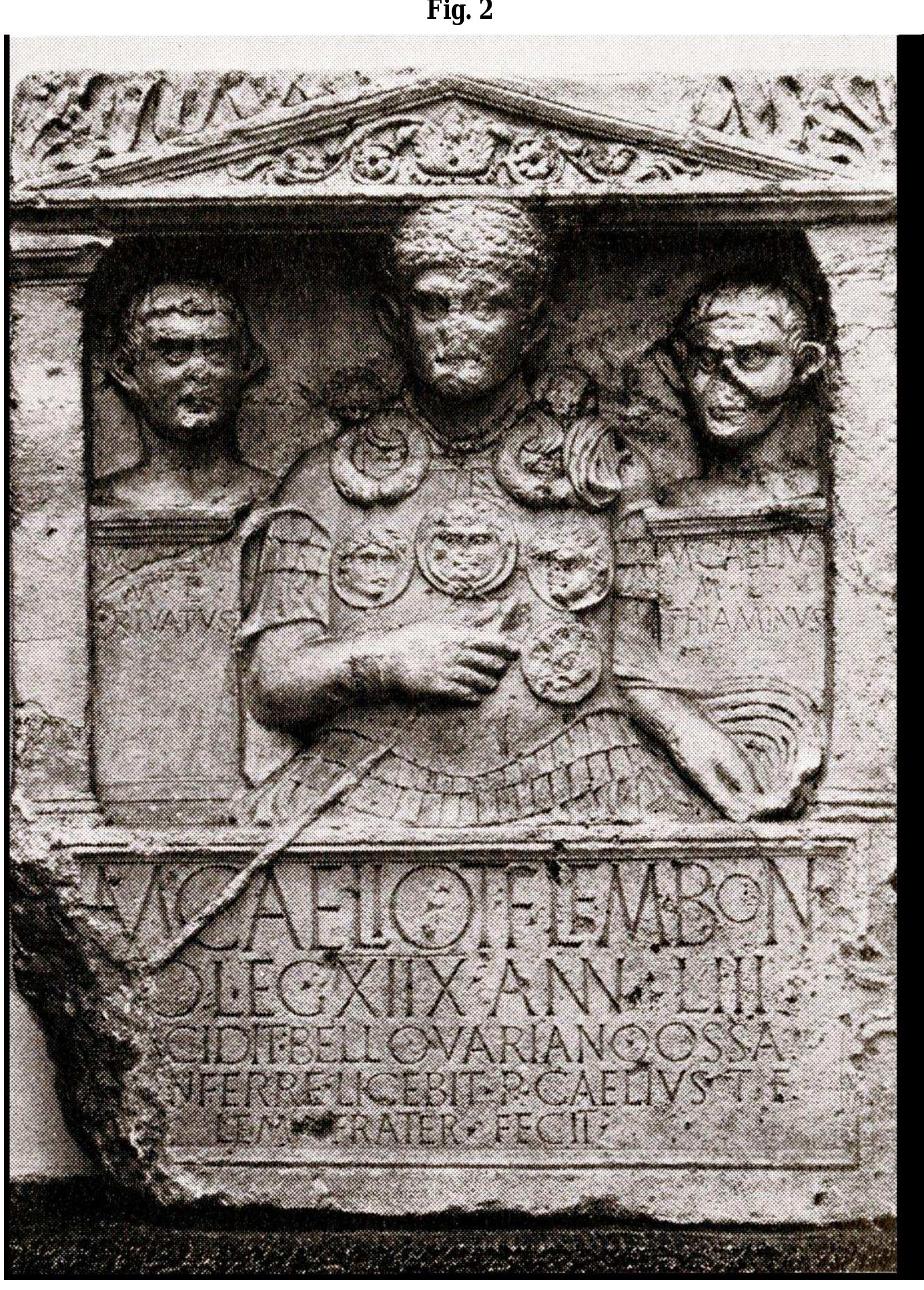
moreThis dissertation examines the military and social roles of centurions in the Roman legions during the Republic and Principate. It combines textual accounts of centurions from such authors as Caesar, Tacitus, and Cassius Dio, as well as epigraphic and archaeological evidence for centurions themselves, including funerary monuments, dedicatory inscriptions, and the physical remains of legionary camps. I evaluate this evidence, moreover, with reference to contemporary military and critical social theory (which integrates concepts of civil-military relations, performance, and symbolic systems), considering the centurion not only in the context of the Roman legions, but in broader Mediterranean warfare and society.
I argue that centurions were at once the linchpin of the legions’ social and military, hierarchy and the chief representatives of the Roman Emperor’s power at the periphery of the empire. By showing the critical functions of the intermediate members of Rome’s legions, this research challenges scholarship that assumes the supremacy of elite military and political values in shaping Roman attitudes towards warfare and imperialism. I show, moreover, that military authority in the Roman army was often quite fluid, and I identify various contexts in which it was disputed or redefined.
The dissertation is organized into six chapters. The first chapter describes the centurion’s disciplinary role in the Roman army. Centurions were responsible for both discipline and punishment in the legions, and by analyzing their reputation for severity, I reassert the significance of corporal punishment in developing Roman military culture. Chapter Two investigates the centurion’s idealized behaviour in warfare, and how it affected views towards leadership and personal authority in the Roman legions. The third chapter demonstrates how these seemingly contrasting ideals of severe discipline and outrageous aggressiveness in combat were complementary rather than contradictory practices in Roman attitudes towards warfare, and that this perceived balance was crucial to the development of the legion’s ranks and organization during the Principate.
Chapter Four evaluates legionary centurions’ rank and social status in the legions, including their career paths, military expertise, and training. Using papyrological and epigraphic evidence in particular, I show how centurions identified themselves as part of a corporate body, distinct from both the rank-and-file and aristocratic leadership. The fifth chapter explains their intermediate position in the legion’s social hierarchy between soldiers and aristocratic commanders, and how this position was important to integrating new soldiers into the Roman military community. Finally, Chapter Six assesses the political and administrative roles of centurions in imperial administration, arguing that they were the chief representation of Roman power among local populations at the periphery of Rome’s empire.
In organizing the chapters according to the centurions’ various statuses and functions (e.g., combat, institutional discipline, camp management, diplomacy, regional administration), the dissertation concomitantly traces the social, political, and institutional development of the centurionate from Republic to Principate, including its cultural representations. I demonstrate that although the centurions’ traditional role on the battlefield increasingly gave way to more bureaucratic duties, they conversely became more emblematic of Roman martial traditions in their vestments, equipment, and cultural image – a military anachronism, and reflective of a broader trend in which the vestiges of an idealized Republican army endured in the professional legions of the later Principate. This dissertation, therefore explores not only the functions, but the identity and self-image of these officers.
This dissertation contributes to scholarship in two fundamental ways. Primarily, it is the first study that combines and analyzes such a broad array of textual, epigraphic, and archaeological evidence for centurions, including duties, characterizations, and expectations. In doing so, the dissertation offers the first comprehensive, scholarly study of legionary centurions in the Roman Empire. Second, the dissertation demonstrates that this analysis of Roman intermediate ranks and social positions is crucial to understanding how attitudes towards discipline, violence, masculinity, and personal authority were manifested both within the Roman military community and throughout the Roman Empire.




![Fig. 6. Ratios of activities involving men and lions. becomes apparent when focusing on the basic components used to construct individual scenes. To take the example of lion imagery, we have creatures with obvious traits that allude to killing, violence, bravery and hunting; all of which are traits that we also expect to find celebrating humans who specialise in such activities (Shapland 2010). In rather obvious juxtapositions we find scenes of a man walking alongside a lion or framed heraldically by lions, but we also have slightly less obvious cross-references in scenes of lions hunting animals, man hunting animals, lions enjoying spoils of hunt, man enjoying spoils of hunt, man as master of lions, man hunting lion, man fighting lion, lion fighting lion, man fighting man (Fig. 6; see also Bloedow 1992). Similarly with hound and bull imagery implicating warriors and bravery, we have warrior walking with hunting hound, hound hunting bull, man hunting bull, man wrestling with bull, man leaping (dominating) bull, man and hound hunting man (Fig. 7). A related pattern is apparent with the relationship between man and ibex as a symbolic game animal (Fig. 8). In several seal images one animal attacks another (e.g. Platon and Pini 1984, no. 344 [Fig. 9]) or a lone prey animal is depicted (e.g. Platon and Pini 1984, no. 337), sometimes with a figure-of-eight shield and/or a spear mysteriously floating in the image (Miller and Pini 1999, no. 248 [Fig. 10]). These may be seen to draw allusions between animal and human behaviour or concerns, inferentially or directly. Where warfare, hunting, sacrifice, religion or bravery conflate as power within these cross-referential networks is open to question, but it is clear that this complex iconographic grammar, or ‘representational code’ (Chryssoulaki 1999b, 111), cannot be](https://figures.academia-assets.com/30349689/figure_005.jpg)

![Fig. 8. Ratios of activities involving men and ibexes. on other artistic media (Morris 1990; Haysom 2010). While the grammar, syntax and context of these weapons and armour evolved beyond a purely martial character, the origins of these symbols in the military sphere illustrates the adoption of attributes related to martial praxis by religious agents (be they deities or worshippers). Haysom (2010, 51) argues that ‘the a prion privileging of these [religious] spheres in our examination of networks of contextual association is likely to be unrealistic — just because a symbol is religious in one context does not necessarily mean it is religious in all contexts’. Morris (1990, 155) considers the shields and helmets to have operated as multivocal symbols ‘whose interlinked spectrum of referents included both warfare and hunting, the protection of man and his territory, and man’s interaction with the natural world’. The double-axe, figure-of-eight shield and boar’s tusk helmet may be seen as conflations of martial and religious spheres that were equally relevant to both. A broad comparison may be seen in the use of tools and weapons to characterise some later European deities such as Athena, Artemis, Thor or Lugh, none of whom were considered to be ‘war deities’.](https://figures.academia-assets.com/30349689/figure_007.jpg)




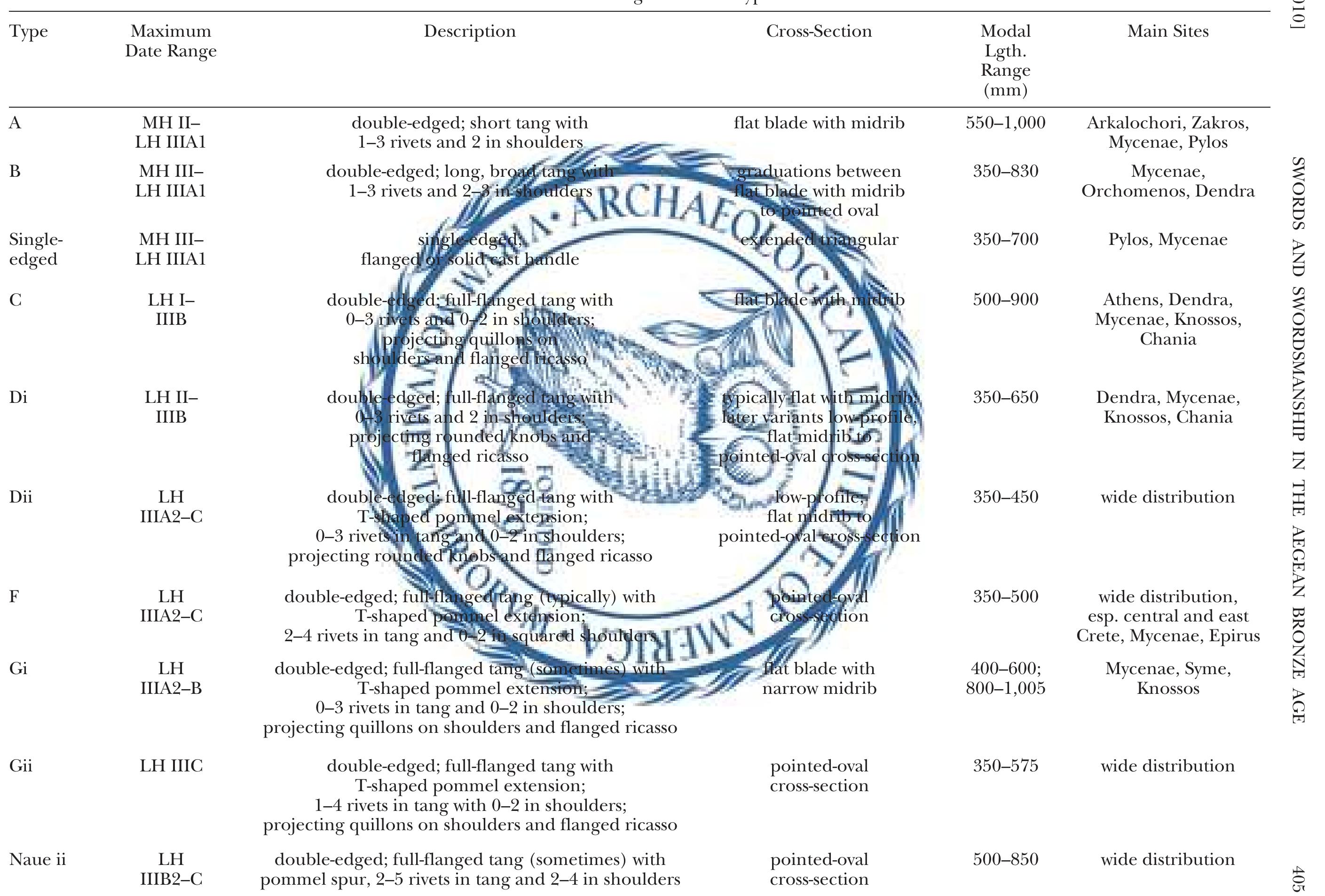
![°° Fourteen pieces are known (Fortenberry 1990; Kilian- Dirlmeier 1993). These typically weighed 250-400 g. *> At least 39 pieces are known (Fortenberry 1990; Kilian- dirlmeier 1993). 31 This blade section is also found on some later Type Di swords. One example comes from Hagios Sylas in Crete (Her- aklion, Heraklion Archaeological Museum, inv. no. 4467 [Io- annidou-Karetsou 1985; Kilian-Dirlmeier 1993, no. 136]). Another example comes from Mavro Spilio, Chamber Tomb XVII (Heraklion, Heraklion Archaeological Museum, inv. no. 2141 [Forsdyke 1926-1927; Kilian-Dirlmeier 1993, no. 142]).](https://figures.academia-assets.com/48596213/figure_003.jpg)


![*4Similarity can be noted between the Type A swords from graves at Mycenae (Karo 1930) and the palace at Zakros (Pla- ton 1966). The same can be said for the Type C swords from graves at Zapher Papoura (Evans 1906) and the shrines at Kato Syme (Lembesi 1975); and Dodona (Athens, National Archaeological Museum, Karapanos Collection, inv. no. 140 [Sandars 1963, 145]). The Type Gi sword from Zapher Pa- poura, Grave Tomb 14 (Heraklion, Heraklion Archaeologi- cal Museum, inv. no. 1102 [Evans 1906]), equates well with an example from the acropolis hoard (Tsountas 1891, 25-6) from Mycenae (Athens, National Archaeological Museum. inv. no. 2537). 7 This term is preferred to “warrior burials,” as it reflects the nature of representation rather than suggesting a reality of identity in life. es Eg, the Type A-related sword from Zapher Papoura, Tomb 44 (Heraklion, Heraklion Archaeological Museum,](https://figures.academia-assets.com/48596213/figure_008.jpg)